Why Choose Cat6 Network Cabling for Optimal Performance?
Efficient network infrastructure underpins every modern business, and Cat6 cabling delivers the speed and reliability Southern California organizations demand. When slow connections and intermittent dropouts threaten productivity, choosing Cat6 network cabling ensures robust throughput, expanded bandwidth, and superior signal integrity. In this guide, we explore key speed and throughput advantages, interference reduction features, future-proofing benefits, comparisons with Cat5e and Cat6a, industry-specific applications across Orange County to San Diego, Ring and Ping Communications’ professional installation process, and everyday business concerns about Cat6 Ethernet cable. Armed with these insights and local expertise, decision makers can confidently upgrade to a resilient, high-performance network foundation.
What Are the Key Speed and Bandwidth Benefits of Cat6 Network Cabling?
Cat6 network cabling provides higher frequency and data throughput than earlier Ethernet standards, enabling faster transfers and more concurrent applications. By operating at up to 250 MHz and supporting 10 Gbps speeds over 55 meters, this cabling addresses large file transfers, cloud services, and multimedia streaming without latency. These advantages translate into measurable productivity gains and improved user experiences for businesses of every size.
How Does Cat6 Ethernet Cable Support 10 Gigabit Ethernet Speeds up to 55 Meters?
Cat6 cable construction features tighter pair twists and improved insulation, delivering 10 Gbps throughput over runs up to 55 meters. This performance leap stems from rigorous pair-twist specifications and an enhanced conductor gauge, which reduces attenuation and enables high-speed signaling over standard patch-panel-to-workstation distances.
Introduced comparisons illustrate the difference:
| Cable Type | Bandwidth (MHz) | Max Speed (Gbps) | Effective Length (m) |
|---|---|---|---|
| Cat5e | 100 | 1 | 100 |
| Cat6 | 250 | 10 | 55 |
| Cat6a | 500 | 10 | 100 |
This comparison confirms how Cat6 bridges the gap between legacy cabling and enterprise-grade infrastructure, preparing networks for evolving demands.
Why Is Higher Bandwidth (250 MHz) Important for Business Networks?
Operating at 250 MHz frequency allows Cat6 Ethernet cable to carry more data streams simultaneously, which supports video conferencing, virtualization, and hosted applications without congestion. Higher bandwidth mitigates packet collisions and reduces latency under heavy loads, ensuring seamless multitasking for accounting software, VoIP calls, and real-time analytics. By increasing capacity, Cat6 Ethernet cable enhances network efficiency and user satisfaction.
How Does Cat6 Improve Network Efficiency Compared to Older Cables?
Compared to Cat5e and earlier standards, Cat6 reduces crosstalk and near-end interference through refined pair-twist geometry and superior insulation materials. This efficiency gain reduces retransmissions and error rates, lowers CPU overhead on network devices, and shortens data transfer times. Businesses benefit from consistently high throughput and predictable performance even as user counts and application complexity grow.
How Does Cat6 Network Cabling Reduce Interference and Ensure Signal Integrity?
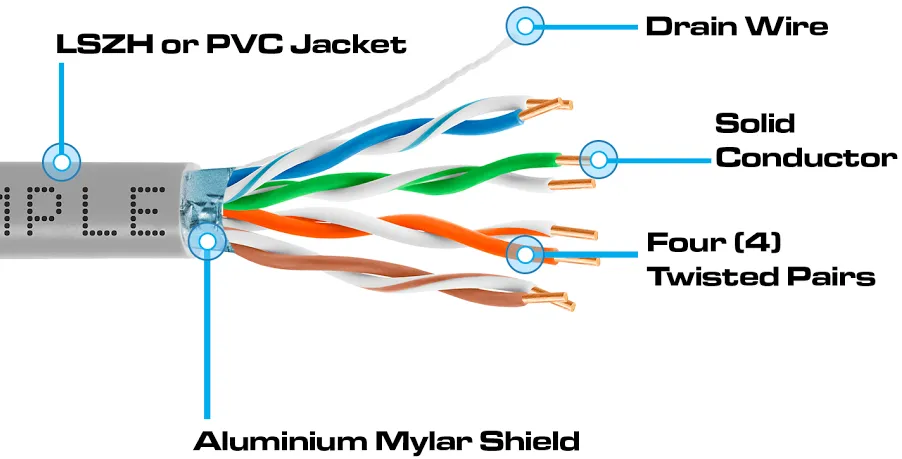
Cat6 network cabling incorporates design features that minimize electromagnetic interference and preserve waveform fidelity, resulting in stable, error-free connectivity. Improved isolation between twisted pairs, along with optional shielding, enhances resilience to electrical noise, enabling reliable data delivery in demanding environments.
What Design Features Minimize Crosstalk in Cat6 Cables?
Cat6 cables use tighter twists per inch, a separating spline or core, and premium dielectric insulation to block pair-to-pair interference. Shielded options (FTP or STP) use foil or braided metal layers to protect against external noise. Together, these elements deliver significant crosstalk reduction, preserving signal clarity across the entire run.
By suppressing unwanted interference at the cable level, Cat6 ensures consistent throughput and fewer packet errors—an essential factor for mission-critical applications.
Why Is Reduced Interference Critical for Industrial and Office Environments?
Industrial machinery, wireless transmitters, and densely populated office floors generate electrical noise that can corrupt Ethernet signals if cabling lacks robust shielding. Reduced interference ensures that automated controls, VoIP systems, and secure data transfers remain uninterrupted. For manufacturing lines and busy call centers alike, this reliability translates to minimal downtime and sustained operational efficiency.
How Does Cat6 Future-Proof Your Business Network Investment?
Investing in Cat6 network cabling positions businesses to meet current demands while accommodating emerging technologies, which maximizes lifespan and return on investment. By supporting modern power and wireless standards and providing backward compatibility, Cat6 cabling reduces upgrade disruption and extends the life of the infrastructure.
How Does Cat6 Support Emerging Technologies Like Wi-Fi 6 and PoE?
Cat6’s high throughput and low attenuation enable networks to support Wi-Fi 6 access points, delivering theoretical speeds up to 9.6 Gbps. The cable’s improved conductor gauge and thermal characteristics enable advanced Power over Ethernet (PoE Types 3 and 4), delivering up to 60–90 watts per port for devices such as IP cameras, phones, and wireless APs. This dual data-and-power capability simplifies deployments and reduces separate electrical wiring requirements.
What Are the Benefits of Backward Compatibility with Cat5e Infrastructure?
Cat6 connectors and patch panels use the same T568A/B wiring schemes as Cat5e, enabling seamless integration with existing cabinets and jacks. Businesses can upgrade critical backbone segments to Cat6 while maintaining peripheral Cat5e links, enabling phased rollouts that minimize operational impact and capital outlay. This compatibility speeds deployment and preserves previous investments.
What Are the Differences Between Cat6, Cat5e, and Cat6a for Business Use?
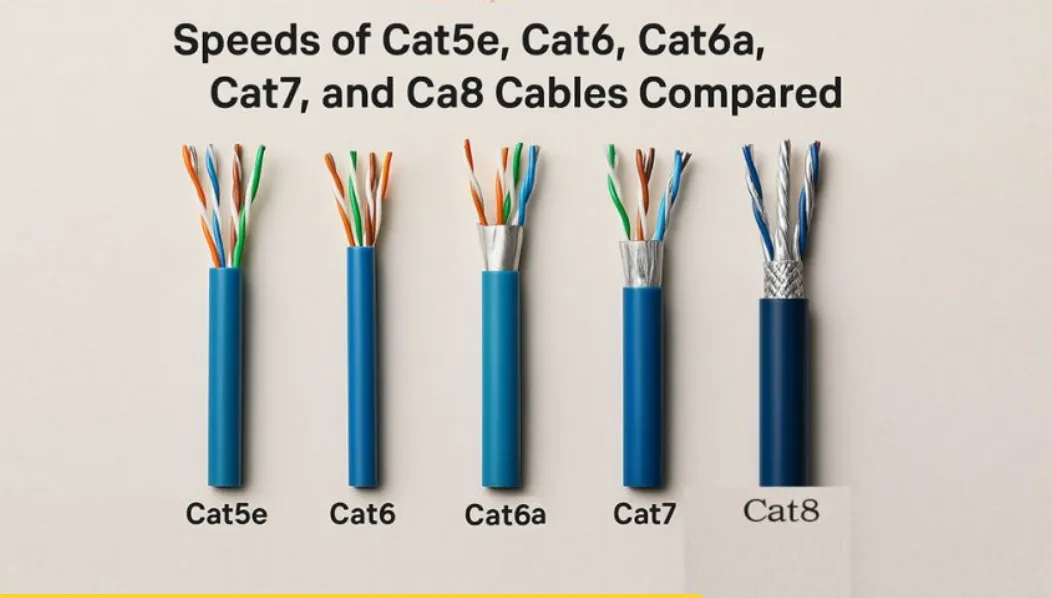
Choosing the right cable involves balancing performance, distance, cost, and deployment complexity. Cat5e, Cat6, and Cat6a each occupy distinct roles in structured cabling, and understanding their specifications informs strategic network design.
How Does Cat6 Outperform Cat5e in Speed, Bandwidth, and Reliability?
Cat6 doubles Cat5e’s bandwidth and delivers ten-fold speed improvement within 55 meters by enforcing stricter signal-to-noise requirements. Enhanced insulation and precise pair geometry yield lower error rates and fewer retransmissions. The table below details core differences:
| Cable Type | Frequency (MHz) | Throughput (Gbps) | Crosstalk Reduction | Ideal Application |
|---|---|---|---|---|
| Cat5e | 100 | 1 | Standard | Basic office networks |
| Cat6 | 250 | 10 (≤55 m) | High | Data centers, call centers |
| Cat6a | 500 | 10 (≤100 m) | Very high | Campus backbones, PoE+ |
When Should Businesses Consider Upgrading to Cat6a Instead of Cat6?
Cat6a cabling becomes necessary when 10 Gbps connections must span up to 100 meters or when maximum PoE power levels are required without temperature derating. Data centers, multi-building campuses, and high-density wireless deployments benefit from Cat6a’s extended performance envelope and enhanced alien-crosstalk suppression.
What Are the Cost and Installation Considerations for Each Cable Type?
Upgrading to Cat6 typically entails moderate material and labor costs and minimal changes to existing pathways, whereas Cat6a requires thicker cables, larger conduit space, and more careful bend-radius management. Material pricing increases by 10–20 percent for Cat6a versus Cat6, and installation labor can rise by a similar margin due to cable stiffness and handling requirements.
How Does Cat6 Network Cabling Benefit Specific Industries in Southern California?
Tailored cabling strategies unlock unique advantages in warehousing, medical, financial, call center, and legal environments throughout Orange County, LA County, Riverside County, and San Diego County. By matching industry requirements with Cat6 attributes, businesses achieve optimal reliability and performance.
What Advantages Does Cat6 Provide for Warehousing and Manufacturing?
Cat6 supports real-time inventory tracking, automated conveyor controls, and IoT sensor networks by ensuring low-latency data transfer across large facilities. Its interference resistance prevents machinery-induced noise from disrupting Ethernet signals, enabling consistent uptime for barcode scanners, RFID readers, and robotic systems.
How Does Cat6 Ensure Reliable and Secure Networks for Medical and Finance Sectors?
Cat6 Ethernet cable delivers the high throughput and stable connectivity required for electronic health record access, diagnostic imaging transfers, and transaction processing. Enhanced shielding options help maintain HIPAA and PCI compliance by reducing electromagnetic emissions and preserving data integrity in critical care and banking applications.
Why Is Cat6 Ideal for Call Centers and Legal Offices?
Call centers rely on VoIP quality that demands minimal jitter and packet loss, while legal offices require secure file transfers and reliable remote access sessions. Cat6’s high bandwidth and low error rates support simultaneous voice, video, and data services without congestion or quality degradation.
What Is the Professional Cat6 Installation Process by Ring and Ping Communications?
Ring and Ping Communications applies a proven methodology that combines local expertise with systematic quality assurance, ensuring rapid deployment and enduring network reliability. Their seamless process guides clients from initial planning through post-installation validation.
What Are the Steps in a Seamless Cat6 Installation from Consultation to Testing?
- Needs Assessment and Site Survey – Gather business requirements, map existing pathways, and identify optimal cable routes.
- Custom Design and Documentation – Produce schematic diagrams, bill of materials, and wiring standards aligned with TIA/EIA guidelines.
- Cable Installation and Termination – Run Cat6 cables, install patch panels and wall jacks, and label all connections for easy maintenance.
- Performance Testing and Certification – Verify continuity, crosstalk, attenuation, and return loss to certify each link meets or exceeds standards.
This structured approach minimizes downtime and delivers a fully documented network ready for immediate use and future audits.
Why Choose Ring and Ping for Cat6 Network Cabling in Southern California?
With deep roots in Orange County, LA County, Riverside, and San Diego, Ring and Ping Communications specializes in seamless Cat6 upgrades completed in as little as one day. Their one-stop shop offering covers fiber, voice, and data cabling, while a guaranteed 24-hour response ensures prompt support. This combination of local presence, broad expertise, and rapid turnaround sets a new standard for network infrastructure services.
What Are the Most Common Questions About Cat6 Network Cabling?
Businesses often evaluate the necessity, comparative advantages, and investment implications of Cat6 cabling when planning network upgrades. Key considerations include whether Cat6 is essential for current operations, how it compares with older cable types, and which budgetary and compatibility factors should guide deployment decisions. Addressing these concerns head-on helps streamline project planning and ensures clear expectations for performance and cost.
Ring and Ping’s consultants note that Cat6 is essential for organizations requiring higher throughput and reliability, as it delivers up to 10x the speed over typical office distances. They also explain that while Cat6a extends performance further, Cat6 remains the most cost-effective standard for most single-building installations. Detailed cost estimates and compatibility analyses further demystify the upgrade path, empowering businesses to make informed infrastructure investments.
Cat6 cabling’s blend of speed, bandwidth, interference suppression, and future-proofing makes it the go-to choice for modern commercial networks. By partnering with local experts who guarantee rapid responses and comprehensive service, organizations across Southern California can secure a high-performance foundation that supports growth, innovation, and uninterrupted operations.
Transitioning to Cat6 network cabling transforms connectivity from a potential liability into a strategic asset. Contact Ring and Ping Communications today to discuss your project requirements, receive a tailored quote, and take the first step toward a faster, more reliable business network.