Strategic IT infrastructure planning for businesses: a practical strategy and roadmap
Strategic IT infrastructure planning is the disciplined work of aligning network, cabling, power and security with your business goals so systems run reliably, scale predictably, and cost less to operate. Drawing on years of industry leadership and certified expertise, this guide explains how a coordinated infrastructure strategy reduces downtime, lowers operating costs, and enables digital initiatives through choices like structured cabling, fiber optics, and commercial electrical design. You’ll get a step-by-step roadmap for assessment, design, implementation, and lifecycle management, plus practical guidance on cabling options, redundancy patterns, and industry-specific recommendations for warehouses, healthcare sites, and offices. We focus on measurable outcomes—faster mean time to repair, predictable capacity upgrades, and lower total cost of ownership—and demonstrate how governance and monitoring keep infrastructure aligned with changing needs. Along the way, we use proven concepts such as backbone design, modular topology, and future-proofing tactics (e.g., reserve pathways and spare capacity). The article closes with actionable deliverables and templates to simplify vendor selection and decision-making.
Why strategic IT infrastructure planning matters for business growth
Good infrastructure planning sets a clear technical baseline that links business goals to physical assets and operational practice, creating predictable performance and controlled risk. By defining bandwidth targets, segmentation, and redundant power feeds, planning turns business objectives into technical requirements that improve uptime and throughput. A robust architecture lets you stand up new services faster, reduces incremental deployment costs, and enables predictable refresh cycles that protect capital spending. Below, we show how focused infrastructure work improves operational metrics and how future-proofing choices reduce long-term operating expenses and technical debt.
Maximizing operational efficiency starts with concrete architecture choices that reduce latency, isolate faults, and simplify maintenance. Designing for redundancy — hot‑swappable parts and clear failover paths — shortens mean time to repair and improves SLA performance and application availability. For example, separating voice and data traffic and provisioning appropriate bandwidth reduces jitter for real‑time apps while lowering congestion for back‑office systems. Those operational mechanics lead directly to why future‑proofing—higher‑spec cabling and spare conduit—preserves growth options without disruptive retrofits.
How does an IT infrastructure strategy boost operational efficiency?
A clear infrastructure strategy aligns topology, cabling, and power with service expectations to reduce failures and speed recovery. Redundancy — dual uplinks, parallel power circuits and alternate fiber routes — removes single points of failure and makes isolation and replacement straightforward, lowering mean time to repair. Capacity planning for bandwidth and I/O keeps peak loads from degrading transactional systems, so user experience stays stable during growth or seasonal spikes.
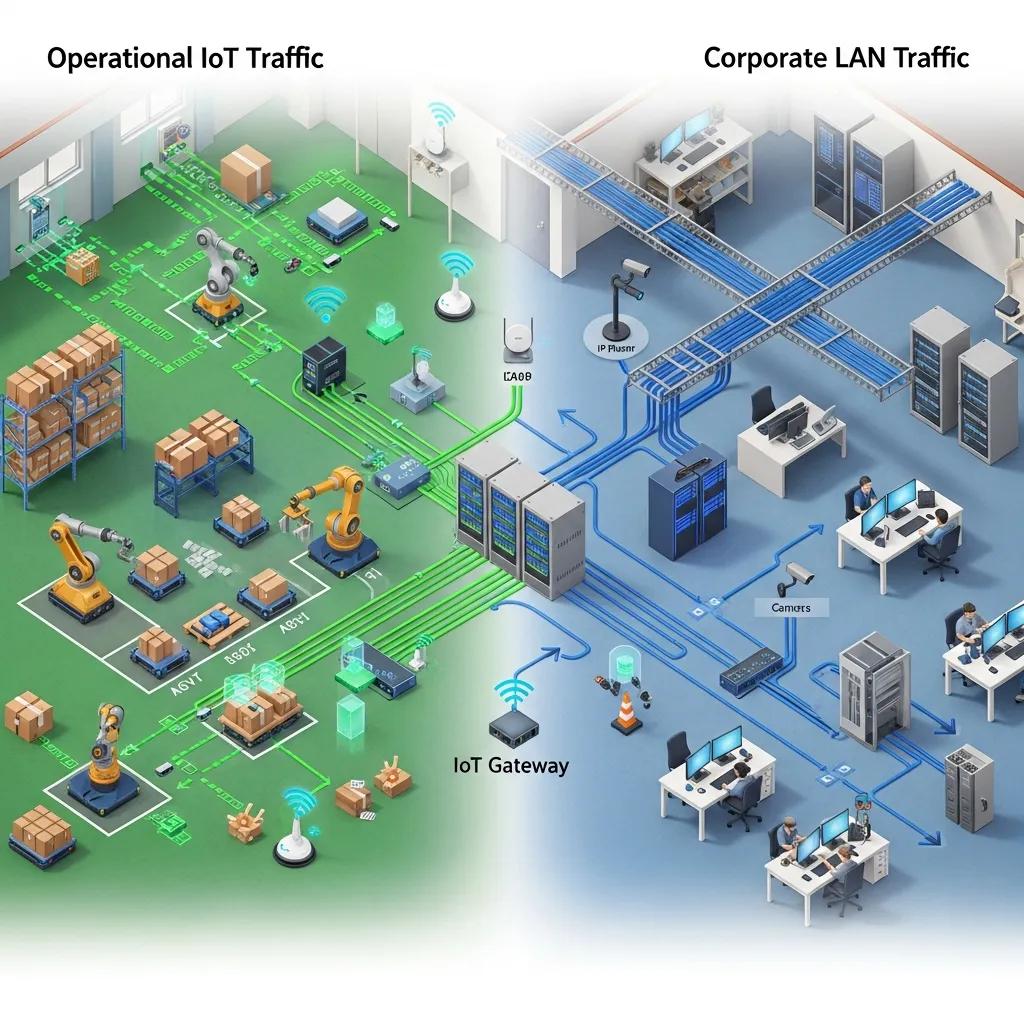
For example, a warehouse that separates operational IoT traffic from the corporate LAN maintains real‑time telemetry without affecting office productivity. That simple topology choice directly improves business workflows.
Those efficiency gains intersect with long‑term choices that prevent repeated rework and rising costs. Viewing operational efficiency at a systems level helps teams prioritize investments that deliver the most uptime and productivity per dollar. That connection between immediate performance and strategic infrastructure sets up the discussion on future‑proofing.
What role does future‑proofing play in network architecture planning?
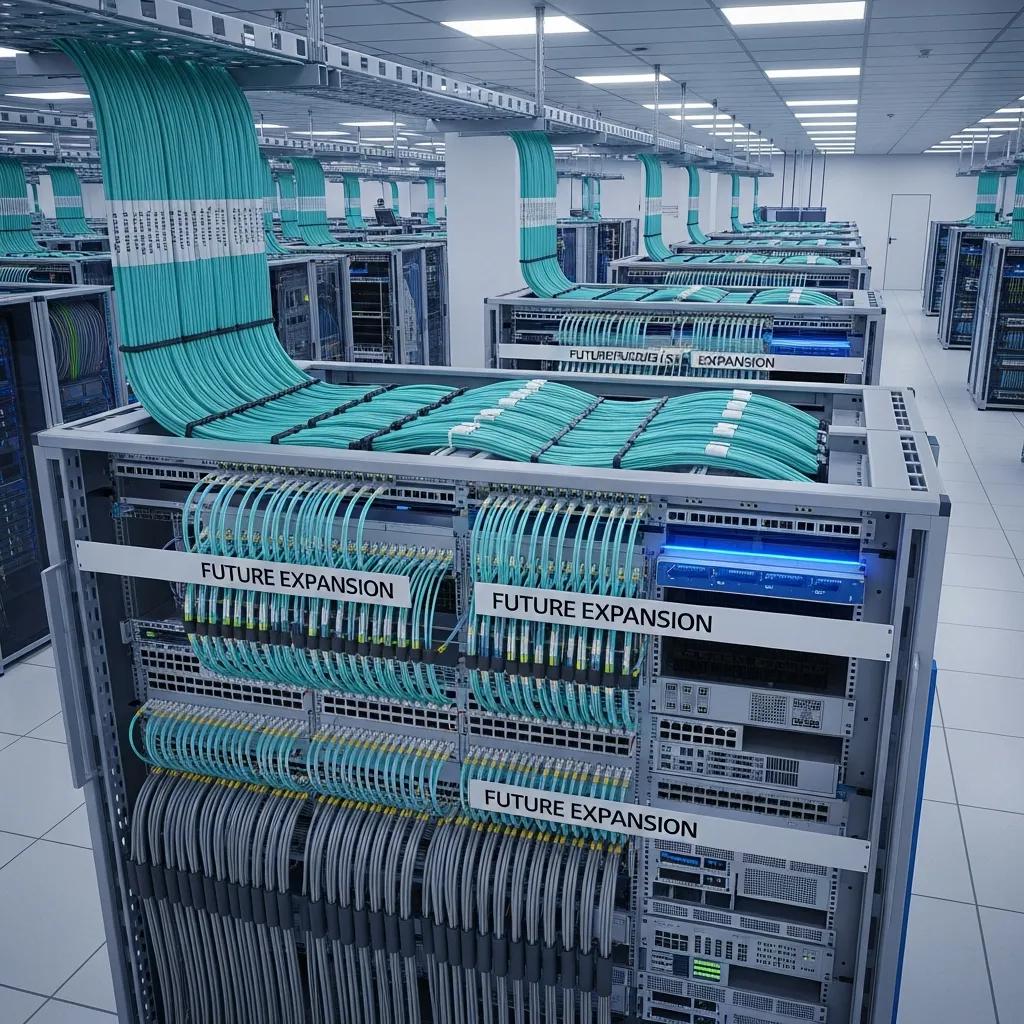
Future‑proofing means installing scalable, modular infrastructure — OM4 fiber backbones, CAT6A horizontal cabling, and conduit for spare pathways — so you can absorb foreseeable capacity and technology changes without significant rework. Paying a modest premium up front often lowers lifecycle costs by avoiding frequent tear‑outs and ad‑hoc upgrades; the long‑term value of preserved upgrade options typically outweighs short‑term savings. Practical tactics include overspecifying backbone capacity, leaving spare patch panels and service loops, and sizing racks and power for denser equipment. Choosing OM4 for backbone runs today, for example, makes future multi‑gig aggregation far less disruptive as you scale.
Implementing future‑proofing requires balancing CAPEX and OPEX—deciding which systems to overspecify and where to provide spare capacity —leading to the core technical components that underpin any resilient plan. Understanding those components helps teams make targeted tradeoffs between short‑term needs and long‑term flexibility.
What are the core components of adequate IT infrastructure planning?
Core components include a structured cabling backbone, fiber links for aggregation, commercial electrical installations for stable power and redundancy, security and access control systems, and governance for lifecycle and capacity management. Each part has a role: cabling and fiber carry data reliably, electrical systems keep equipment powered and protected, security enforces access and monitoring, and governance keeps changes aligned with business strategy. The compact comparison below shows how cabling choices affect capacity and distance limits, which shape roadmaps and vendor specs.
| Technology | Characteristic | Typical Capacity |
|---|---|---|
| CAT6 | Cost‑effective copper for horizontal runs | Up to 1 Gbps typical; 10 Gbps possible up to 55 meters |
| CAT6A | Augmented copper for higher performance | Stable 10 Gbps for horizontal campus deployments up to 100 meters |
| OM3 Fiber | Multi‑mode backbone fiber | 10 Gbps to 40 Gbps over moderate distances (up to 300 meters for 10 Gbps) |
| OM4 Fiber | Optimized multi‑mode for higher density | 40 Gbps to 100 Gbps over longer intra‑site links (up to 400 meters for 10 Gbps) |
| OS1 Single‑Mode | Long‑distance single‑mode fiber | Gigabit to 100+ Gbps for site‑to‑site and metro links |
How do cabling and fiber support enterprise IT roadmaps?
Cabling and fiber are the physical highways for data — they shape latency, throughput, and upgrade paths. Copper (CAT6/CAT6A) typically connects workstations and edge devices, while multi‑mode or single‑mode fiber forms the backbone that aggregates switches and links buildings or data centers. Following TIA/EIA and structured cabling best practices ensures predictable performance and simpler certification. Choosing higher‑grade fiber like OM4 lets you migrate to higher link speeds without re‑cabling, making future expansions, edge compute rollout, and traffic segmentation easier to plan.
Picking the right media requires assessing current demand, projected growth and the cost of civil interruptions — a natural lead into the electrical work that must support these systems reliably.
Why is commercial electrical installation critical to robust IT infrastructure?
Commercial electrical installation provides the power framework for every networked device and determines availability, redundancy and safety. Good designs allocate dedicated circuits to critical racks, plan UPS and generator capacity for extended outages, and comply with NEC code to reduce fire and thermal risk. Electrical planning must account for rack densities, inrush currents and PDU distribution to avoid overloads and thermal stress that shorten equipment life. A solid electrical baseline also enables graceful failover for critical services, and integrating power monitoring into your management plane supports proactive maintenance and capacity planning.
Seeing power as a core element clarifies why integrated planning — cabling, electrical and environmental controls together — produces the most predictable business outcomes and simplifies end‑to‑end vendor delivery.
How does Ring and Ping Communications deliver tailored IT infrastructure solutions?
Ring and Ping Communications offers one‑stop low‑voltage and electrical services: network cabling, fiber optics, commercial electrical installation, surveillance, access control and audio‑visual systems delivered as coordinated projects. Our delivery model covers the full lifecycle — site assessment, engineered design, certified installation, testing and ongoing support — which reduces coordination risk between trades and simplifies warranties and accountability. Key client benefits include a 90-day labor guarantee and a lifetime manufacturer’s warranty on certified cabling, protecting both workmanship and materials after handover. For urgent needs, our rapid‑response protocol aims to connect clients with a team member within 24 hours to clarify remediation and scheduling.
The section below breaks down the typical assessment, design and implementation steps we follow to turn a technical roadmap into reliable deliverables, with examples of project artifacts you should expect.
What is the assessment, design and implementation process?
A disciplined infrastructure project follows the following phases: discovery and site survey, requirements capture, engineering and design, implementation and testing, and handover, including documentation and warranty registration. In discovery, we map cabling backbones, aisle and rack densities, and electrical panels, producing floor plans and risk analyses. Design delivers network diagrams, cable schedules, and bills of materials specifying CAT6A or OM4 fiber where appropriate. Implementation uses certified installers for structured cabling runs, fiber splicing, labeling and certification testing, with test reports for each channel; electrical work adds dedicated circuits and UPS installation. Deliverables typically include as‑built drawings, test certificates and maintenance recommendations that support predictable lifecycle planning and capacity governance.
Clear handover artifacts and certified installations enable operations teams to maintain service levels and plan refresh cycles methodically, rather than relying on undocumented vendor work. With those deliverables in hand, warranties and guarantees become the client’s final reassurance.
How do warranties and guarantees protect long‑term reliability?
Warranties and guarantees shift specific risks from the client to the installer and manufacturer by defining coverage for workmanship, materials and performance over set periods, which reduces budget and operational uncertainty. A labor guarantee covers the installer’s remedial work for workmanship issues during the warranty period; a manufacturer’s lifetime warranty on certified cabling covers material defects when the cabling is installed and certified to testing standards. When evaluating warranty terms, review coverage duration, conditions that void the warranty and whether link certification documentation is required — knowing these details prevents surprises during post‑install troubleshooting. A practical checklist (ask for certification reports, scope of labor coverage and transferability) helps procurement and IT teams compare proposals objectively.
Understanding warranty boundaries lets organizations accept installations confidently and supports long‑term reliability planning, which ties into industry‑specific needs covered next.
Which industry‑specific infrastructure solutions address unique business needs?
Different industries impose different constraints: warehouses require rugged cabling and careful wireless planning; manufacturing demands EMC and power-resilient designs; healthcare requires redundancy and compliance‑driven designs; and offices prioritize scalability and occupant comfort. Effective planning maps environmental and operational constraints to technical patterns — shielded cabling and conduit for interference mitigation, fiber for building backbones, and redundant power for critical clinical systems. The table below links common industry challenges to recommended technologies and installation practices to guide roadmap choices.
| Industry | Industry Challenge | Recommended Solution |
|---|---|---|
| Warehouse | Large open spaces, RF variability, and mechanical damage risk | Shielded cabling, elevated trays, planned AP density, fiber backbone |
| Manufacturing | Electrical noise, heavy machinery interference, and high-power loads | Shielded/armored cabling, isolated conduit, dedicated circuits, edge compute placement |
| Healthcare | High availability, regulatory sensitivity, and hygiene constraints | Redundant fiber backbones, dual‑power feeds, accessible pathways for service, secure access control |
| Office | Flexible layouts, growth, mixed‑use floors | CAT6A horizontal cabling, modular patching, spare conduit, centralized backbone fiber |
What challenges and solutions apply to warehousing and manufacturing?
Warehouses and manufacturing floors expose cabling to mechanical risk, RF interference and high ceilings that complicate wireless coverage. Mitigations include routing fiber in protected trays or conduit above impact zones, using shielded or armored cabling in noisy areas, and conducting AP site surveys to size AP density, power, and antenna orientation. Power planning should include isolated circuits for automation equipment, and UPS‑backed feeds for critical control systems to avoid process interruptions. Combined with edge compute nodes to reduce latency in control loops, these measures deliver robust performance in challenging environments and reduce unplanned downtime.
Implementing these solutions requires coordination across the network, electrical, and operations teams so cabling pathways and power feeds align with mechanical and safety constraints. That coordination supports optimization of healthcare and office environments, as discussed next.
How are healthcare and office environments optimized through strategic planning?
Healthcare facilities emphasize redundancy, secure access control and minimal downtime for life‑critical systems; offices focus on flexibility, user experience and easy expansion. In healthcare, planning includes dual power feeds, ring topology fiber for resiliency, segregated clinical VLANs and documented maintenance windows for safe patching. Office optimizations use CAT6A horizontal cabling, spare pathways for future APs and AV/conferencing integration into the structured cabling plan. Both environments benefit from certified cabling and documented test reports that support warranties and compliance audits, delivering predictable performance and easier support.
These industry patterns show how tailored planning reduces operational friction and aligns technical choices with business risk profiles, preparing organizations for the standardized assessment and scalable roadmap we outline next.
How can businesses build and maintain a scalable IT infrastructure roadmap?
A scalable roadmap starts with a thorough assessment, moves into prioritized design and phased implementation, and continues with monitoring, lifecycle planning and periodic reassessment so the architecture stays aligned with business objectives. The roadmap favors modular phases that deliver incremental value — backbone upgrades first, then horizontal refreshes, then service enablement — minimizing disruption while expanding capacity. Governance controls such as change control, capacity thresholds and refresh triggers make timing and budgeting predictable. The short checklist below is a practical playbook teams can adopt.
- Conduct a full site assessment to document power, cabling, rack densities, thermal profiles and security controls.
- Prioritize gaps by business impact and address backbone and power issues before edge upgrades.
- Execute phased implementation with certified installers, testing and documented handover artifacts.
- Deploy monitoring and maintenance schedules with defined refresh triggers and periodic reassessments.
These steps create a repeatable cycle for growth and resilience that supports digital transformation while controlling cost and risk. The table below maps common assessment areas to expected outputs and recommended next steps for the roadmap.
| Assessment Area | Key Findings | Recommendation |
|---|---|---|
| Power | Panel capacity and single points of failure identified | Add redundant circuits, UPS, and generator planning |
| Cabling | Age, certification gaps, and missing spare pathways | Replace with CAT6A/OM4 where needed; install spare conduit |
| Redundancy | Single uplink or single power feed risks | Implement dual uplinks and parallel power feeds |
| Security | Access control and monitoring gaps | Integrate access control and centralized monitoring logs |
After you establish the roadmap, embed reassessment procedures and vendor‑managed warranties to protect performance over time. When you’re ready to move from roadmap to execution, Ring and Ping Communications can perform site assessments and provide project bids. Our coordinated low‑voltage and electrical scope, 90‑day labor guarantee, lifetime manufacturer’s warranty on certified cabling and rapid response protocols are designed to streamline delivery and simplify long‑term maintenance. Using a single provider for cabling, fiber and electrical work reduces coordination overhead and consolidates warranty responsibility, making refresh planning easier.
What steps are involved in assessment and scalable solution planning?
An effective assessment uses a checklist that reviews power capacity, cabling quality, physical pathways, rack and thermal density, security posture and service expectations to produce a prioritized roadmap. Field work includes as‑built verification, cable certification testing, thermal imaging of racks and power‑load analysis, each producing artifacts such as test reports, floor plans and rack elevations. Outputs rank fixes by impact and cost, separating immediate mitigations from multi‑quarter projects and tying schedules to business cycles. Reassessment cadence — commonly annual or biannual for critical sites — keeps the roadmap current and supports changing digital initiatives without surprises.
This framework helps leaders prioritize work that delivers the biggest reliability and capacity gains and prepares teams to implement monitoring and lifecycle policies that preserve those gains over time.
How does future‑proofing support digital transformation and business continuity?
Future‑proofing lets your infrastructure absorb new applications, edge services and higher bandwidth without disruptive rework. Tactics like overspecifying backbone fiber, provisioning spare conduit and designing racks and PDUs for higher densities let you add edge compute, IoT or analytics incrementally. Those provisions also support business continuity by reducing single points of failure and enabling faster failover or capacity scaling during demand surges or localized outages.
Embedding future‑proofing in the roadmap is both a technical and financial decision that balances near‑term budgets with long‑term operational savings and continuity — the practical end of the roadmap cycle.
What emerging trends influence strategic IT infrastructure planning?
Trends such as edge computing, rising cybersecurity requirements, sustainability goals and pervasive IoT are changing how planners design networks and power systems. Edge computing raises local compute and storage needs, requiring stronger horizontal cabling and local power provisioning; cybersecurity drives segmentation, zero‑trust patterns and tighter monitoring integration. Sustainability goals push toward energy‑efficient components, hot‑aisle/cold‑aisle management and materials choices that lower operational carbon and cost. Anticipating these trends lets infrastructure plans adapt proactively rather than reactively; the sections below cover cybersecurity/edge impacts and sustainability practices in more detail.
How do cybersecurity and edge computing affect infrastructure design?
Cybersecurity and edge computing intersect where topology and segmentation change the attack surface and where latency‑sensitive processing benefits from local resources. Planners should separate zones by trust level and place compute where latency gains justify decentralization. Segmentation (VLANs), physical separation for critical control systems and local security appliances at edge nodes reduce lateral movement risk and speed incident containment. Edge deployments also require local power and cooling planning since small compute clusters near sensors or control systems add rack and power load. These choices balance centralized control against distributed resiliency and must be coordinated with cabling and electrical design to ensure secure, low‑latency operation.
Designing with those constraints preserves performance for emerging workloads while protecting the security posture of critical systems, and it leads into sustainability practices that can be adopted without sacrificing reliability.
Sustainability practices in commercial IT infrastructure focus on energy efficiency, material selection and lifecycle policies that lower environmental impact while improving operating cost. Best practices include optimizing airflow and efficient UPS systems, choosing lower‑loss cabling and higher‑efficiency power supplies, and planning consolidation to reduce footprint and cooling load. Programs for reuse and recycling of decommissioned equipment, selecting durable materials like armored fiber where appropriate, and designing spare but purposeful conduit pathways help reduce lifecycle emissions. These choices typically cut operating expenses while improving corporate sustainability metrics.
Aligning sustainability with resilience and cost objectives ensures infrastructure investments are both future‑ready and environmentally responsible, closing out the core coverage of strategic planning in this guide.
Why Partner with Ring and Ping Communications? Our Unmatched Expertise
With over two decades of dedicated service in Southern California, Ring and Ping Communications stands as a recognized leader in IT infrastructure solutions. Our authority is built on a foundation of deep technical knowledge, rigorous certifications, and a proven track record of delivering robust, scalable, and secure systems for diverse industries.
- Our team comprises industry-certified professionals who adhere to the highest standards, including TIA/EIA, BICSI, and NEC codes, ensuring every project meets stringent quality and safety benchmarks.
Certified Excellence
- Leverage our extensive experience across thousands of successful projects, from complex data center builds to critical healthcare infrastructure and expansive warehouse deployments.
Decades of Experience
- Our confidence in our workmanship is backed by a 90-day labor guarantee and a lifetime manufacturer’s warranty on certified cabling, providing unparalleled peace of mind.
Guaranteed Reliability
We don’t just install infrastructure; we engineer solutions that drive your business forward, ensuring optimal performance, security, and future readiness.
Ring and Ping Communications — next steps and contact guidance
Ring and Ping Communications is a Southern California one‑stop provider for low‑voltage and commercial electrical projects, offering network cabling, fiber optics, surveillance, access control, audio‑visual systems and commercial electrical installation. Our service model emphasizes fast response to inquiries, a 90‑day labor guarantee on workmanship and a lifetime manufacturer’s warranty on certified cabling to reduce client risk and simplify long‑term maintenance. If you’re pursuing an assessment or project bid, request a site survey that delivers as‑built drawings, cable test reports and a prioritized roadmap so you can compare technical and financial tradeoffs objectively. To get started, contact Ring and Ping Communications through our official channels to request an assessment, confirm warranty details and schedule a rapid‑response consultation.
- Request a Site Assessment: Ask for floor plans, cable test reports and a prioritized roadmap.
- Compare Warranties: Verify 90‑day labor guarantees and lifetime manufacturer’s warranty on certified cabling.
- Schedule Phased Work: Implement backbone and power upgrades first, then horizontal refreshes to minimize downtime.
Frequently Asked Questions
What are the key benefits of a well‑planned IT infrastructure?
A well‑planned IT infrastructure delivers clearer operations, less downtime and smoother scalability. When infrastructure aligns with business goals, teams can allocate resources more efficiently and avoid surprise costs. A strategic approach also improves risk management and keeps systems ready for future demands. In practice, this leads to predictable performance and faster responses to market or technology changes, supporting steady business growth.
How can businesses assess their current IT infrastructure needs?
Start with a comprehensive site evaluation that reviews power capacity, cabling condition, and security controls. Gather inventory data, identify single points of failure, and measure performance. Engage stakeholders to capture operational needs and growth plans. Document findings and produce a prioritized roadmap that addresses urgent gaps while planning for longer‑term improvements to keep infrastructure aligned with business objectives.
What role does vendor selection play in IT infrastructure projects?
Vendor choice directly affects quality, reliability and total cost. Evaluate experience, track record and warranty terms — a strong vendor supports the full project lifecycle from assessment to maintenance. Also review their approach to compliance, security and sustainability to ensure solutions meet industry standards and your strategic goals. Clear scope, certifications and warranty detail make vendor comparisons far more objective.
How can organizations ensure compliance with industry regulations?
Build regulatory requirements into infrastructure planning from the start. Identify applicable rules (data protection, industry standards) during assessment and design controls, access policies and audit processes accordingly. Regular audits, staff training and governance frameworks help keep the infrastructure compliant as regulations evolve, reducing legal and operational risk.
What common pitfalls should organizations avoid in infrastructure planning?
Common mistakes include skipping thorough assessments, ignoring future scalability and failing to involve key stakeholders. Missing documentation for existing systems often leads to costly rework, and overlooking growth can quickly make infrastructure obsolete. Engaging all relevant departments early ensures that technology choices align with operational needs and avoids miscommunication and project delays.
How does ongoing monitoring support infrastructure effectiveness?
Continuous monitoring lets you spot and fix issues before they escalate. Monitoring tools track performance, detect anomalies and confirm systems run within defined parameters. That oversight supports timely maintenance, better resource use and improved reliability. Regular monitoring also helps teams adapt to changing demands and keeps infrastructure aligned with business priorities over time.
Conclusion
Strategic IT infrastructure planning aligns technology with business goals to improve efficiency, reduce downtime and enable growth. Following a clear, phased roadmap ensures scalability and adaptability while keeping costs under control. Partnering with a trusted provider like Ring and Ping Communications can simplify delivery and provide solutions tailored to your needs. Take the next step: request a site assessment to begin optimizing your infrastructure today.