Common Electrical Problems and Solutions for Commercial Buildings
Commercial electrical problems are faults in a building’s power distribution, protection, and consumption systems that interrupt operations, cause safety hazards, and increase costs. These issues arise from overloaded circuits, aging consumer units, transient surges, and degraded wiring. Diagnosing them requires methodical electrical troubleshooting and knowledge of UK safety standards such as BS 7671 and EICR. This article explains common commercial electrical faults, how to analyze them, practical repair and prevention strategies, relevant UK compliance requirements, and ways to improve energy efficiency using modern energy management systems. Readers will learn step-by-step fault-finding checklists, when to escalate to professional commercial electrical services, and the comparative benefits of solutions like dedicated circuits, surge protection, and emergency power. The following sections cover the most common faults, diagnostic procedures, best preventative and remedial options, applicable UK standards, energy-efficiency measures, the financial impacts of failures, and common FAQ-style answers to support rapid decision-making and compliance planning.
What Are the Most Common Electrical Faults in Commercial Buildings?
Common commercial electrical faults are recurring issues in power distribution and protection that create downtime, risk, and equipment damage. These faults often manifest as power outages, circuit breaker trips, faulty wiring leading to shocks or fire risk, flickering lighting, and power surges that damage sensitive electronics. Understanding these failure modes directly improves troubleshooting and mitigation. Identifying these faults early reduces operational disruption and informs prioritized upgrades such as consumer unit refurbishment, surge protection installation, and load redistribution. The next paragraphs list the most frequent faults and provide concise indications for businesses to consider when deciding between in-house checks and professional intervention.
Commercial premises typically encounter five practical fault categories to monitor:
- Power outages: Loss of supply, either from the supplier or due to internal distribution failure.
- Circuit overloads and trips: Repeated MCB or RCD trips caused by sustained or transient excessive loads.
- Faulty wiring and earthing failures: Degraded conductors, poor terminations, or missing bonding, leading to shocks or heating.
- Lighting faults and flicker: Driver failures, loose connections, or upstream voltage variation affecting fixtures.
- Power surges and transient events: External or internal surges causing latent electronic damage.
These fault categories guide targeted inspection and immediate safety steps before deeper fault finding, which is described in the following subsection.
Which Electrical Issues Cause Power Outages in Businesses?
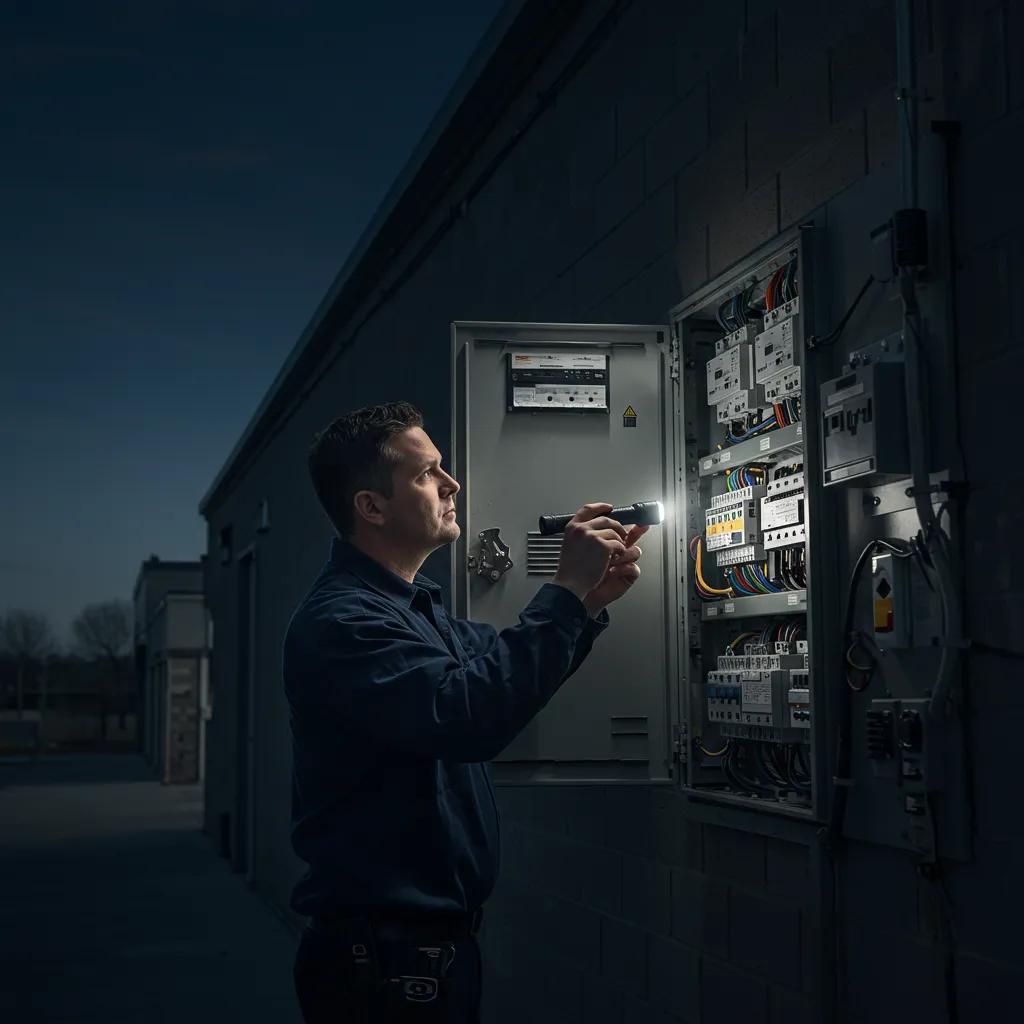
Power outages in businesses are caused by external supply interruptions, faults in the distribution board, or local equipment failures that isolate circuits. The mechanism determines response urgency. Supplier-side outages typically affect whole estates and require coordination with the network operator, while internal outages often stem from damaged busbars, failed breakers, or distribution board faults that isolate critical circuits. Immediate checks include verifying upstream supply presence, inspecting the consumer unit for visible damage, and confirming whether upstream protection has operated; these checks establish whether emergency power or a professional electrician is needed. Knowing the likely source of an outage helps determine whether to deploy temporary power, isolate affected equipment, or commence targeted repairs, which is the focus of the next subsection.
What Causes Frequent Circuit Breaker Trips and Overloads?
Repeated circuit breaker trips in commercial settings usually result from sustained overloads, short circuits, earth faults, or incorrectly specified protective devices, and recognizing the trip type helps pinpoint the fault. Overloads occur when the cumulative load from HVAC, production machinery, or temporary equipment exceeds circuit capacity, while short circuits and earth faults often indicate damaged insulation, loose terminations, or faulty equipment. Practical checks include load profiling to identify peak demand, isolating suspect equipment, and verifying MCB characteristics against connected equipment ratings; these steps enable planning for dedicated circuits or panel upgrades. Redistributing loads and fitting correctly rated protective devices reduces nuisance trips and improves operational continuity, which ties into wiring integrity considerations discussed next.
How Do Faulty Wiring and Electrical Shocks Occur in Commercial Properties?
Faulty wiring and electrical shocks can result from conductor deterioration, poor terminations, inadequate earthing, or installations that fail to meet BS 7671 requirements, posing immediate safety risks. Environmental factors such as moisture, vibration, rodent activity, or mechanical damage accelerate insulation breakdown, while overloaded connectors and loose terminations increase contact resistance and heat generation. Warning signs include hot sockets, burning smells, visible arcing, or unexplained RCD trips. If you detect these signs, isolate the circuit and engage a qualified electrician for an EICR-led inspection. Proper earthing and bonding, confirmed through inspections and tests, are essential to eliminate shock pathways and form the basis for compliance-led remedial works described later.
Why Do Commercial Lights Flicker and How Can It Be Fixed?
Commercial lighting flicker is usually caused by loose connections, failing drivers in LED fittings, ballast or transformer faults, or supply voltage fluctuations, and diagnosing the level (fixture vs supply) clarifies the fix. Fixture-level issues often present on single circuits or groups and are resolved by replacing drivers or securing terminations. At the same time, supply-side flicker shows broader building impacts that may need distribution board checks or supplier engagement. Simple tests include swapping a suspected lamp with a known good fitting, checking neutral and phase continuity at the fitting, and recording voltage using a meter to identify fluctuations; successful fixes often combine targeted replacement with improved junction box terminations. Upgrading to modern LED drivers and addressing upstream distribution weaknesses not only improves energy efficiency but also reduces long-term maintenance, thereby connecting consumption to system health.
How Does High Energy Consumption Affect Commercial Electrical Systems?
Sustained high energy consumption stresses consumer units, cables, and protective devices, increases heat-related aging, and magnifies the risk of overloads and failures, making consumption patterns a key diagnostic indicator. Inefficient equipment, poor power factor, and uncontrolled loads drive higher operating costs and accelerate insulation deterioration and breaker cycling. At the same time, peak demand events can trigger wide-scale trips or penalties on tariffs. Conducting energy audits and deploying energy management systems helps quantify load profiles, identify high-consumption equipment, and recommend targeted interventions such as load shifting, power factor correction, and equipment replacement. Reducing consumption through audits and technology upgrades not only lowers bills but also directly extends component life and reduces emergency call-outs, which leads naturally into practical diagnosis and troubleshooting frameworks.
How Can You Diagnose and Troubleshoot Electrical Problems in Commercial Buildings?
Diagnosing commercial electrical problems is a systematic process of safety checks, isolation, measurement, and elimination to identify root causes and plan remediation efficiently. The mechanism relies on structured electrical troubleshooting: confirm safe conditions, isolate affected circuits, use meters and thermal imaging to collect evidence, and compare readings against expected values and historical patterns to localize faults. Effective diagnosis reduces downtime and guides whether temporary power, part replacement, or complete panel refurbishment is appropriate, and it prepares concise documentation for compliance and repair planning. The next section outlines a step-by-step fault-finding checklist tailored to commercial premises, including tools and escalation criteria.
A concise checklist summarises the core fault-finding workflow:
- Safety first: Verify isolation, use PPE, and confirm RCDs are functional before any intervention.
- Document symptoms: Record which circuits, times, and equipment are affected to spot patterns.
- Measure and monitor: Use clamp meters, multimeters, and thermal cameras to capture live data safely.
- Isolate and test: Remove loads, test components individually, and retest protection devices.
- Escalate: Call a professional if live mains work, earthing faults, or fire-smell issues are present.
This structured approach ensures safe, repeatable diagnosis and yields data that informs the next phase: identifying surges, supply irregularities, and when to call specialists.
What Are the Steps for Effective Commercial Electrical Fault Finding?
Effective fault finding combines safety, data collection, and elimination techniques to identify root causes rather than symptoms, and this structured approach reduces repeat failures. Begin with a risk assessment and isolation of affected circuits, perform visual inspections for overheating, corrosion, or physical damage, then use a thermal camera to detect hot spots and a clamp meter to record load currents under normal operating conditions. Log voltage and current trends to spot transient events and conduct RCD and insulation resistance tests where applicable; keep detailed records to support EICR reporting and remedial planning. If the issue involves mains-level equipment, complex protection coordination, or concealed wiring defects, escalate to a qualified commercial electrician for safe remediation and certification, as the following subsection explains further.
How to Identify Causes of Power Surges and Electrical Failures?
Power surge diagnosis distinguishes between external transients from the supply network and internal surges created by switching events or faulty equipment, and identifying the source directs mitigation choices. Evidence of surge damage includes burnt traces on PCBs, repeated failure of electronics, or surge arrestor operation; monitoring tools such as power quality analyzers and event loggers capture transient amplitudes and timing to correlate with incidents. Deploying temporary monitoring across the incoming supply and key distribution points helps separate supplier-side spikes from internal switching, and the data informs surge protection placement and class selection. Once causes are identified, implementing staged surge protection from the service head to distribution boards reduces the risk of future damage and supports continuity plans described later.
When Should You Call a Professional Commercial Electrician?
You should call a professional commercial electrician for safety-critical events, complex distribution faults, or when work involves mains, earthing, certificates, or permanent modifications to systems, because qualified contractors provide safe, compliant solutions and documentation. Immediate professional intervention is required for shocks, burning smells, repeated RCD trips, main incomer failures, or any situation where isolation and testing would expose untrained staff to live conductors. For planned upgrades, EICR remediation, or installation of emergency power systems, a qualified electrician ensures designs meet BS 7671 and supports compliance evidence needed by insurers and regulators. Preparing a concise fault log, meter readings, and details of affected equipment helps the electrician diagnose faster and reduces on-site time, leading into the range of preventative and remedial solutions that follow.
What Are the Best Solutions to Prevent and Repair Commercial Electrical Faults?
Preventing and repairing commercial electrical faults combines short-term fixes with long-term upgrades to protect equipment, maintain continuity, and meet compliance obligations. Mechanisms include installing dedicated circuits for high-load equipment to prevent overloads, deploying appropriate surge protection at the service head and distribution levels, fitting UPS or generators for emergency power, and adopting scheduled preventative maintenance such as thermography and insulation testing. Selecting the right mix depends on load profiles, criticality of systems, and budget, with priority given to safety-critical protections and EICR-identified remedial actions. The following subsections explain dedicated circuits, emergency power, preventative maintenance, and common upgrade options that improve safety and compliance.
Dedicated circuits reduce the chance of overloads by isolating high-demand equipment on its own protected feeder, ensuring correct protective device sizing and avoiding shared loading problems. A dedicated circuit is specified by matching conductor size, breaker rating, and protective coordination to the equipment’s continuous and starting currents; this arrangement prevents nuisance trips, reduces voltage dip during motor starts, and improves safety. In practice, motors, ovens, CNC machines, and packing lines benefit from dedicated feeds to protect both the equipment and the rest of the distribution system. For businesses that need professional design and installation, Ring and Ping Inc. offers dedicated circuit installation as part of its commercial electrical installation services, ensuring circuits are sized and protected correctly to support reliability and safety.
How Does Dedicated Circuit Installation Prevent Overloads?
A dedicated circuit prevents overloads by assigning a single protective device and appropriate conductor to one high-load item, eliminating cumulative loading effects that cause trips. This mechanism ensures the protective device operates only for faults on that circuit and not due to other equipment loads, improving selectivity and reducing collateral outages. Benefits include improved equipment performance, reduced nuisance trips, and clearer fault localisation, which shortens repair times and limits production loss. Correct specification and professional installation also ensure compliance with BS 7671 and help plan future load expansions, supporting the next discussion on emergency power options.
What Emergency Power Solutions Are Available for Commercial Properties?
Emergency power options for commercial properties include UPS systems for short bridging of critical electronics, standby generators for extended outages, temporary site power for works, and microgrid arrangements for resilience; each technology serves a specific response time and duration need. UPS systems provide immediate, clean power for servers, security, and critical control systems during the gap before generators start, while standby generators supply long-duration power with appropriate automatic transfer switching and fuel planning. Sizing considerations include critical load lists, start-up currents for motors, and the need to maintain safety systems; regular testing and maintenance are essential to ensure readiness. Ring and Ping Inc. has experience delivering emergency power solutions and coordinating temporary power to minimise downtime and maintain business continuity during outages.
How Can Preventative Maintenance Reduce Electrical Failures?
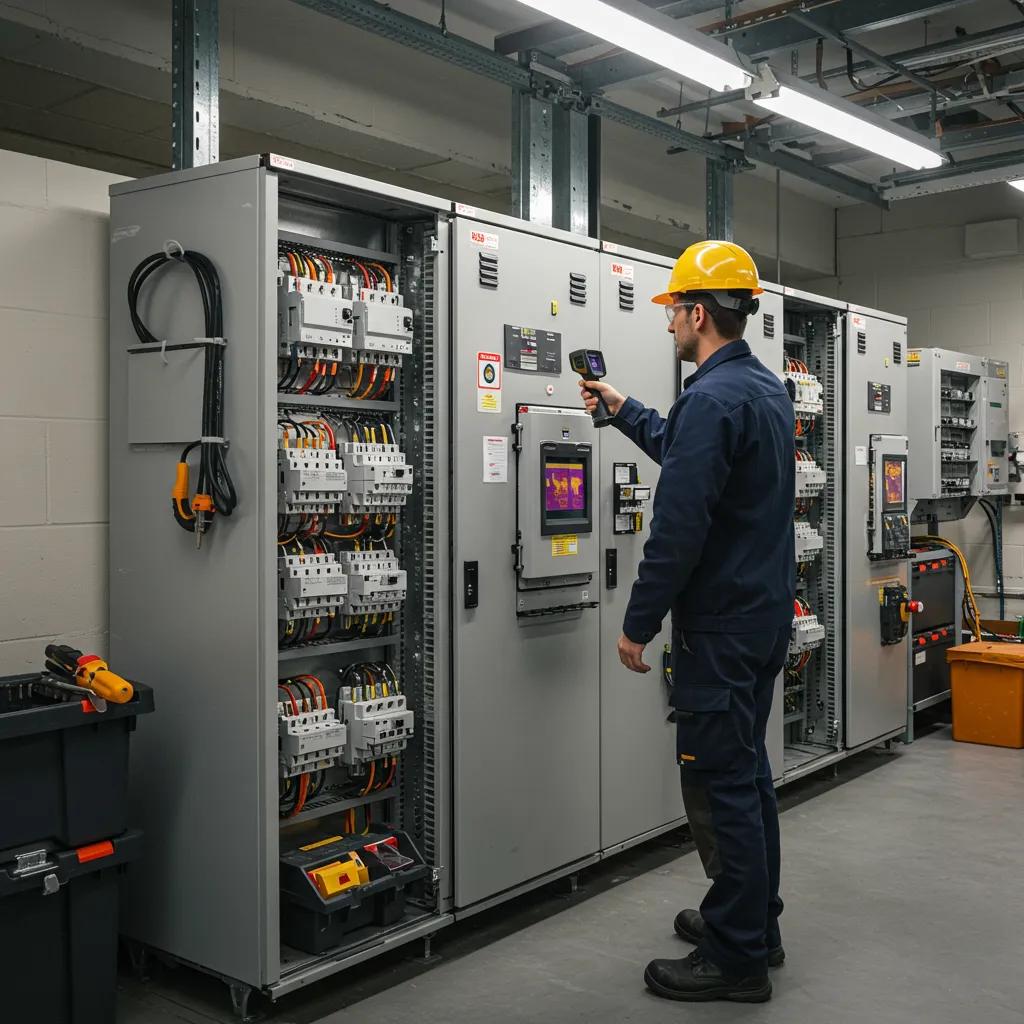
Preventative maintenance reduces failures through scheduled inspections, thermal imaging to detect hot connections, periodic insulation resistance testing, and functional RCD testing, which together detect deterioration before it causes outages. A typical maintenance schedule combines monthly visual checks, annual thermographic surveys, and 3–5 yearly EICR inspections depending on risk and environment; this approach reduces emergency call-outs and extends equipment life. Measurable benefits include fewer unplanned outages, lower long-term repair costs, improved safety compliance, and planned maintenance supports phased upgrades that minimize operational disruption. For businesses seeking maintenance packages, Ring and Ping Inc. offers preventative maintenance and electrical troubleshooting services, backed by a 90-day labor guarantee that provides additional confidence in completed work.
Before the next section on upgrade types, a comparative table summarises protection options to help businesses choose the right remedy for common fault types.
| Solution | Primary Purpose | Typical Use-Cases |
|---|---|---|
| Surge Protection Device (SPD) | Protects equipment from transients | Incoming supply protection for offices and production lines |
| Dedicated Circuit Installation | Prevents overloads and nuisance trips | Motors, ovens, CNC machines, packing lines |
| UPS (Uninterruptible Power Supply) | Provides immediate bridging power | Servers, security systems, control panels |
| Standby Generator | Sustains long outages | Facilities requiring extended runtime for operations |
This comparison shows how combining layered protections—SPDs, dedicated circuits, UPS, and generators—addresses both safety and continuity. Understanding these roles informs the selection of upgrades discussed next.
What Upgrades Improve Electrical Safety and Compliance in Businesses?
Upgrades that improve safety and compliance include replacing aging consumer units, adding RCD protection, installing surge protection at strategic points, and upgrading distribution boards with modern breakers and arc-fault detection where appropriate. These measures reduce fire risk, enhance selectivity, and ensure installations meet BS 7671 requirements, while documentation such as certificates and updated schematics supports EICR outcomes and insurer expectations. Planning upgrades in stages with temporary power arrangements and clear testing schedules minimizes operational impact and provides demonstrable compliance evidence. Prioritizing safety-critical items identified in inspections ensures remedial funds are used efficiently and supports long-term resilience.
Which UK Electrical Safety Standards Apply to Commercial Buildings?
UK electrical safety standards for commercial buildings are principally BS 7671 for design and installation and the Electrical Installation Condition Report (EICR) process for inspection and testing, both of which define legal and industry expectations for safety. BS 7671 specifies requirements for protection, earthing, bonding, circuit design, and equipment selection to ensure systems are safe. At the same time, EICR provides a documented assessment of condition with coded recommendations that drive remediation. Compliance requires both correct design/installation practices and periodic inspection/testing to demonstrate ongoing safety; the next subsection summarises key BS 7671 requirements businesses must prioritize.
| Standard / Document | Key Requirement | What Businesses Must Do |
|---|---|---|
| BS 7671 | Correct system design, protection, and earthing | Ensure installations follow the standard at design and during upgrades |
| EICR | Inspection, testing, and coding of defects (C1/C2/C3) | Schedule EICR, remediate C1/C2 items promptly and record C3 as advisory |
| Surge protection guidance | SPD selection and placement | Install SPDs at the service head and distribution where required by risk assessment |
This mapping clarifies that standards translate to specific inspection regimes, remedial priorities, and documentation that businesses must maintain. The following subsections unpack these obligations and the EICR role.
What Are the Key Requirements of BS 7671 for Commercial Properties?
BS 7671 requires safe design, adequate circuit protection, correct earthing and bonding, and proper selection of protective devices to guard against overloads, earth faults, and electric shock, forming the foundation of compliant installations. It mandates the use of RCDs where necessary, suitable coordination of MCBs and RCDs, and attention to wiring methods and containment suited to commercial environments, ensuring personnel and property safety. Businesses must adopt these principles in both new installations and upgrades, and reflect changes during EICR-driven remediation planning. Understanding these requirements leads directly to how EICR outcomes should be used.
How Does the Electrical Installation Condition Report Ensure Safety?
The EICR is a documented inspection that identifies defects, rates their severity using codes (C1: danger present, C2: potentially dangerous, C3: improvement recommended), and recommends remedial action and timelines; the report guides prioritized repairs. An EICR provides a snapshot of installation condition and is often required by insurers or landlords to verify safety; businesses use the report to schedule remedial works and demonstrate compliance. Prompt remediation of C1/C2 items and recording completion updates the safety record and supports ongoing maintenance planning, which aligns with why surge protection and other mitigations are considered mandatory in many contexts.
Why Is Surge Protection Mandatory in UK Commercial Electrical Systems?
Surge protection is effectively mandatory where risk assessments or standards require it to protect critical equipment and maintain safety; SPDs prevent transient overvoltages from damaging electronics and causing operational failure. SPDs are classified by protection levels and location—type 1 at the service head, type 2 at the distribution, and type 3 near sensitive equipment—and correct placement reduces the cumulative stress that shortens equipment life. Best practice involves combining staged SPD installation with regular testing and coordination with earthing to ensure effective discharge paths. Businesses should view SPDs as essential components of a holistic resilience strategy.
How Can Energy Efficiency Be Improved in Commercial Electrical Systems?
Improving energy efficiency in commercial electrical systems reduces costs and lowers stress on distribution infrastructure, achieved through targeted audits, LED retrofits, controls, and adoption of energy management systems (EMS). Mechanisms include load profiling to identify waste, power factor correction to reduce reactive power charges, smart controls to shift loads to off-peak periods, and sensor-driven HVAC and lighting to eliminate unnecessary consumption. Benefits include lower energy bills, reduced peak demand, and extended equipment life. The following subsections describe innovative technologies, audit steps, and EMS selection criteria to help businesses act.
What Are the Benefits of Smart Building Technologies for Energy Savings?
Innovative building technologies reduce waste by monitoring occupancy, controlling lighting and HVAC, and enabling predictive maintenance, which in turn translates into measurable energy and operational savings. Benefits include lower baseline consumption, reduced reactive maintenance, and the ability to implement demand-response strategies that favor tariff optimization. Initial integration costs are offset by energy savings, reduced downtime, and more precise capital planning data based on actual usage patterns. The next subsection explains how to audit systems to identify the highest-impact interventions.
How to Audit Commercial Electrical Systems for Efficiency?
An electrical efficiency audit involves load profiling, power factor analysis, and thermal imaging to identify inefficient equipment, as well as an inventory of legacy devices and control systems that drive unnecessary consumption. Deliverables include a ranked list of interventions, estimated savings, payback periods, and recommended phasing to align with maintenance windows and capital plans. Audits often reveal quick wins—LED retrofits, timer controls, power factor correction—alongside longer-term investments in EMS or plant replacement. Using audit outputs to prioritize work reduces both cost and disruption and helps build the case for integrated EMS adoption, which is described next.
Which Energy Management Systems Are Recommended for Businesses?
Recommended EMS options range from basic monitoring dashboards that visualize consumption to integrated control-capable platforms that automate load shedding, tariff optimization, and predictive maintenance actions; selection depends on the business’s complexity and critical loads. Monitoring-only systems deliver fast insights at low cost, while control-capable EMS require more integration but unlock demand-side response and automated optimization benefits. Selection criteria include scalability, integration with existing BMS, data export capabilities for procurement, and the ability to support phased implementation aligned with maintenance planning. Choosing the right EMS ensures energy savings, complementing safety and continuity measures discussed earlier.
What Are the Financial and Operational Impacts of Electrical Problems in Commercial Buildings?
Electrical faults translate directly into downtime costs, lost productivity, and repair expenses, and quantifying these impacts helps justify preventative investment such as maintenance contracts, surge protection, and resilience systems. Mechanisms include production line stoppages, inability to serve customers or process data, and reputational damage that reduces future revenue; these effects often exceed the immediate repair bill. Presenting comparative costs of reactive repair versus scheduled maintenance and upgrades clarifies ROI and supports board-level decisions to fund resilience projects. The following subsections illustrate how faults create downtime, the comparative costs of ignoring safety, and how professional services reduce disruption.
| Cost Category | Description | Financial Impact / Metric |
|---|---|---|
| Downtime cost | Lost production or sales per hour | Varies by sector; often hundreds to thousands per hour |
| Reactive repair | Emergency call-out and parts replacement | Higher per-incident cost vs scheduled maintenance |
| Preventative maintenance | Scheduled inspections and servicing | Lower annual cost with reduced emergency events |
| Compliance failure | Fines, insurance increases, and reputational loss | Potentially significant one-off and ongoing costs |
This table shows that preventative maintenance typically delivers superior cost-effectiveness by reducing downtime and limiting expensive emergency repairs. The next subsections provide concrete examples and timelines.
How Do Electrical Faults Cause Downtime and Business Loss?
Electrical faults cause downtime via immediate shutdowns of production lines, server outages that halt operations, or emergency evacuations due to smoke or fire risk, and these interruptions often cascade into sales losses and missed deadlines. For example, a tripping incomer or failed motor starter can stop an entire packing line, incurring labor idle time and contract penalties until repair or temporary bypass is implemented. Quantifying the time-to-repair and associated revenue loss helps prioritize investments in redundancy, temporary power, and faster contractor response. Effective contingency planning and staged upgrades reduce these operational exposures, which are costed in the next subsection.
What Are the Costs of Ignoring Electrical Safety and Maintenance?
Ignoring electrical safety leads to higher long-term costs through repeated emergency repairs, accelerated equipment replacement, insurance claims or premium increases, and potential regulatory fines following inspections. Direct costs include emergency call-outs and parts, while indirect costs cover lost revenue, reputation damage, and possible legal exposure after incidents that cause injuries or property damage. Investing in scheduled maintenance typically lowers the total cost of ownership by extending asset lifetimes and reducing the frequency of high-cost reactive interventions. The final subsection explains how professional electrical services mitigate these impacts through planning and execution.
How Can Professional Electrical Services Minimize Business Disruption?
Professional electrical services minimize disruption by offering rapid diagnosis, staged remedial works, temporary power solutions, and coordinated scheduling to execute upgrades during planned downtime, ensuring continuity of operations. Specialists provide certified testing, documentation for compliance, and practical measures such as temporary generators and phased switchovers that keep critical systems running. A coordinated approach that combines fault-finding, targeted repairs, and preventative maintenance reduces repeat faults and shortens recovery times when incidents occur. Preparing clear fault logs and access arrangements in advance further accelerates contractor response and limits business impact.
What Are Common FAQs About Commercial Electrical Problems and Solutions?
This section provides succinct answers to typical business questions, supporting decision-making and capturing common PAA queries with clear, actionable guidance. The answers focus on inspection frequency, what in-house teams can safely check, warning signs of unsafe installations, and expected repair timelines; each response provides decision thresholds and supports escalation to qualified contractors where appropriate. Readers will find practical recommendations for inspection intervals, safe troubleshooting limits, and criteria for urgent professional intervention, which start with inspection scheduling.
How Often Should Commercial Electrical Systems Be Inspected?
Commercial electrical inspection frequency depends on environment and risk: typical schedules range from annual visual checks to complete EICR inspections every 3–5 years, with higher-frequency checks for high-risk or high-use premises. Areas with heavy-duty machinery, harsh environmental exposure, or critical safety systems often require more frequent inspection and testing to maintain operational safety. Continuous monitoring and thermography can supplement interval-based inspections to detect early-stage faults and reduce formal inspection frequency for well-monitored sites. Establishing a risk-based inspection plan ensures resources target the highest-return safety activities and reduces unexpected outages.
Can Businesses Perform Their Own Electrical Troubleshooting?
Businesses can perform basic, safe troubleshooting tasks—such as visual inspections, resetting breakers, checking for noticeable signs of damage, and recording event patterns—but work on wiring, consumer units, or live mains must be performed by qualified electricians. Safe in-house checks include documenting affected circuits, checking indicator lights, restarting non-critical equipment after isolation, and recording voltages if competent staff use safe portable test equipment. Any tasks that involve removing covers from distribution equipment, altering wiring, or performing insulation resistance tests should be deferred to accredited professionals to avoid danger and invalidate insurance. Clear limits on in-house checks reduce risk and ensure proper escalation to professionals when needed.
What Are the Signs of Unsafe Electrical Installations in Commercial Buildings?
Signs of unsafe installations include frequent trips, burning smells, hot sockets, visible arcing, discolored insulation, and exposed wiring, each indicating an urgent need for isolation and professional inspection. Additional indicators are persistent RCD or MCB nuisance trips, unexplained power loss to critical equipment, and inconsistent voltages across outlets. On observing these signs, isolate the affected circuit, avoid using suspect equipment, and arrange an EICR or targeted inspection by a qualified contractor. Prompt action prevents escalation to fire or injury and creates a clear remediation path for compliance records.
How Quickly Can Electrical Repairs Be Completed to Minimize Downtime?
Repair timelines vary: simple fixes, such as replacing a failed driver or tightening connections, can be completed within hours. In contrast, major works like consumer unit replacement, distribution board refurbishments, or panel upgrades may require days and staged switches to maintain continuity. Emergency call-outs often address immediate safety risks within hours, whereas planned upgrades are scheduled to align with operational windows to minimize disruption. Using spare parts, pre-identified contractors, and temporary power arrangements accelerates recovery, and providing the contractor with accurate fault logs and access reduces overall downtime. Businesses should plan for both immediate containment and short-term repair, followed by a longer-term upgrade to prevent future incidents.
Ring and Ping Inc. offers comprehensive commercial electrical installation and troubleshooting services, serving as a one-stop shop for businesses seeking practical solutions and documented compliance. Their service capabilities include lighting installation, outlet and dedicated circuit installation, heavy machinery installation, and emergency power coordination across commercial sectors. For businesses seeking a single supplier to design and execute remedial works and resilience upgrades with a labor guarantee, Ring and Ping Inc. offers targeted packages to support continuity and safety.