Medical Office Cabling & Electrical Services Built for Southern California Healthcare
By Bryn Billman, Senior Solutions Architect at Ring and Ping Communications
John specializes in designing HIPAA-compliant network and electrical systems for healthcare facilities across Southern California, ensuring optimal performance and regulatory adherence.

Medical office cabling and electrical services cover the planning, installation, testing, and ongoing care of low-voltage networks and commercial electrical systems that keep clinics, imaging suites, and administrative operations running safely and efficiently. This guide walks through how structured cabling, fiber backbones, dedicated medical circuits, and emergency power work together to protect patient data, enable telemedicine and PACS workflows, and reduce downtime across Southern California facilities. You’ll find practical, HIPAA-focused cabling requirements, the electrical codes and backup-power strategies that protect clinical operations, fiber recommendations for high-bandwidth needs, security-system integration best practices, and a clear roadmap for upgrades and maintenance. We emphasize the technical controls—segmentation, shielding, isolation transformers, UPS and generator roles—then translate those choices into reliability and compliance guidance. Throughout, we reference current standards like TIA/EIA, NFPA 70 and NFPA 99 so facility planners and IT managers can make informed decisions.
Knowing how cabling design enforces HIPAA physical and technical safeguards is the first step to protecting PHI and keeping clinical workflows online. This section defines the cabling controls relevant to HIPAA, shows testable installation practices, and compares options that balance compliance and performance. After outlining core requirements, we explain how structured cabling supports network segmentation and compare CAT and fiber choices for common clinical scenarios. Together these recommendations frame practical selections for medical office networks and highlight the testing and documentation auditors expect.
What Are the Essential HIPAA Compliant Network Cabling Requirements for Medical Offices?

HIPAA-compliant network cabling integrates physical controls, technical safeguards, and clear testing records to reduce the risk of unauthorized access to Protected Health Information (PHI) when stored or transmitted. Practical implementations include secure cable pathways, locked telecommunications closets, labeled and segregated runs, and shielded cable where electromagnetic interference could affect data integrity. Certified test results with documented pass/fail outcomes provide tangible evidence of compliance, while following TIA/EIA and BICSI best practices keeps installations aligned with industry standards. The checklist below distills the primary cabling items that support HIPAA controls and prepare a facility for reliable operation and audit readiness.
Key cabling requirements include physical separation of PHI systems, consistent labeling and asset documentation, certified testing, and scheduled maintenance. These steps lower the chance of accidental exposure and streamline incident investigations. Next, we show how structured cabling enables network segmentation and physical access control for PHI-bearing equipment.
To compare common cabling options used in clinical settings, the table below summarizes attributes important to HIPAA-sensitive deployments: bandwidth, distance, shielding, and compliance notes.
| Cabling Option | Characteristic | Compliance & Use Notes |
|---|---|---|
| CAT6A (Shielded/UTP) | Up to 10 Gbps at 100 m; option for shielding in EMI-prone areas | Ideal for workstations and VoIP; use shielding near imaging or other EMI sources to protect data integrity |
| Multi-mode Fiber (OM3/OM4) | High bandwidth for short-to-medium distances within buildings (up to 300 m) | Great for in-building backbones and data-center links; limits electromagnetic coupling with PHI devices |
| Single-mode Fiber | Very long-distance, high bandwidth for campus links | Best for campus backbones and remote PACS access; fiber provides physical separation from copper PHI endpoints |
This comparison clarifies when to choose copper versus fiber in clinical environments: shielded copper for endpoint areas with high EMI risk, multi-mode fiber for building backbones, and single-mode for long-haul or campus links. The next subsection looks at the structured cabling controls that enforce these protections in practice.
How Does Structured Cabling Ensure Patient Data Security in Healthcare?
Structured cabling secures patient data by enabling logical network segmentation and robust physical controls that limit access to PHI-bearing devices and storage. Clear pathway documentation, labeled patch panels, and locked telecom closets create an auditable infrastructure that supports physical safeguard requirements. VLAN segmentation and dedicated circuits for medical devices separate PHI traffic from guest and administrative networks, shrinking the attack surface and simplifying monitoring. Certified testing—measuring return loss, length, and continuity—creates verifiable artifacts showing installations meet TIA/EIA standards and supports incident response. Consistent documentation and change logs feed scheduled audits and maintenance programs to preserve compliance over time.
Those mechanisms directly inform cabling decisions for clinical workloads, including when to favor Cat6A or optical fiber for telemedicine and imaging.
Which Cabling Types Support HIPAA Compliance: CAT6, Fiber Optics, and Beyond?
Selecting cabling for HIPAA-sensitive environments balances bandwidth, distance, and immunity to interference while keeping clear pathways for secure data flows. CAT6A delivers 10 Gbps over 100 meters and is cost-effective for workstations and VoIP; shielded pairs are helpful near imaging equipment to reduce interference. Multi-mode fiber suits in-building backbones for EHR servers and PACS aggregation, supporting high throughput over moderate distances (up to ~300 meters). Single-mode fiber is appropriate for campus or long-haul links to off-site storage or centralized PACS. Many projects use a hybrid approach—CAT6A to endpoints and fiber for backbones—to balance performance, isolation, and cost. High-quality terminations, correct connector types, and certified test reports are essential compliance records and should be part of project handover documentation.
Before fieldwork begins, planners should confirm how electrical design and cable pathways interact—see the electrical and emergency power section next.
Ring and Ping Communications provides HIPAA-focused installations emphasizing certified cabling, manufacturer-backed warranties, and clear service guarantees. Our approach combines structured cabling best practices, certified testing, and thorough documentation for audit readiness, backed by a 90-day labor guarantee plus lifetime manufacturer warranty on certified cabling installations. For medical offices wanting a single qualified partner for low-voltage wiring and compliance-focused deployments, contact us to arrange a site evaluation and formal proposal.
How Do Robust Electrical Solutions Support Medical Facility Operations and Safety?
Code-compliant electrical systems keep clinical operations running by delivering dependable distribution, required isolation, and resilient emergency power that maintains critical equipment during outages. Healthcare electrical design must address NFPA 70 (NEC) and NFPA 99, provide dedicated circuits for critical devices, ensure proper grounding, and include testing programs for UPS and generators. Isolation transformers, automatic transfer switches (ATS), and redundant power paths reduce risk to patient safety and sensitive diagnostic equipment. The checklist below outlines electrical readiness items facility managers should verify before commissioning and during maintenance.
Key electrical elements include dedicated circuits for imaging and life-safety devices, UPS for short-term ride-through and power conditioning, and generators sized with automatic transfer switches for extended outages. Clear labeling, selective coordination, and documented test schedules support NFPA guidance and local authority (AHJ) requirements. The table that follows compares power solutions by supported equipment, expected runtime, and code considerations to help planners choose the right configuration.
| Provides ride-through for IT racks, EHR servers, and monitoring systems; enables orderly transfer to the generator | Attribute | Typical Application & Code Considerations |
|---|---|---|
| Dedicated Medical Circuits | Isolated supply lines with labeling | Supports imaging and critical patient devices; aligns with NFPA 99 circuit segregation principles |
| UPS (Uninterruptible Power Supply) | Short-term runtime, clean power conditioning | Provides ride-through for IT racks, EHR servers, and monitoring systems; enables orderly transfer to generator |
| Standby Generator + ATS | Long-duration backup with automatic transfer | Supports building loads during extended outages; requires regular load testing and NFPA-aligned maintenance |
Each solution plays a distinct role: dedicated circuits protect sensitive devices, UPS units condition and bridge short outages, and generators provide long-term power. The next subsection summarizes the key codes that guide these choices.
What Are the Key Electrical Standards and Codes for Healthcare Facilities?
The principal standards for healthcare electrical design are NFPA 70 (NEC) and NFPA 99. Together, they cover wiring methods, emergency power, grounding, and patient-safety requirements that influence equipment selection and installation. NFPA 70 provides the general electrical code, while NFPA 99 addresses healthcare-specific systems and space classifications. Designers must consider these standards alongside local code amendments and coordinate with licensed electrical contractors to meet AHJ requirements. Clear documentation, labeling, and periodic testing are expected outputs and serve as inspection evidence.
With the standards in mind, the next subsection explains how dedicated circuits, UPS, and generator systems are sized and commissioned to meet clinical requirements.
How Are Dedicated Circuits and Emergency Power Systems Implemented in Medical Offices?
Implementing dedicated circuits and emergency power starts with inventorying loads that must remain powered, then performing sizing studies that account for surge and inrush characteristics of imaging and HVAC equipment. UPS systems typically protect IT racks, EHR and PACS servers, and network closets, while generators with ATS handle life-safety and essential building systems for longer outages. Redundancy approaches—N+1 UPS, parallel generators, or diverse feed paths—reduce single points of failure. Commissioning should include simulated transfers, runtime validation, and documented maintenance schedules. Regular load-bank testing and quarterly UPS health checks, all logged, demonstrate readiness and meet auditor expectations.
Once electrical and cabling systems are confirmed, many facilities invest in high-performance fiber backbones for imaging and telemedicine—covered in the next section.
Ring and Ping Communications offers commercial electrical services and emergency-power implementation alongside low-voltage work so a single contractor can coordinate integrated electrical and network projects. Our offerings include dedicated-circuit installation, UPS integration, and generator testing aligned with NFPA guidance. For Southern California medical facilities seeking a coordinated solution, we can assess needs and provide combined cabling and electrical proposals.
What Fiber Optic Solutions Enhance High-Speed Data Transmission in Hospitals and Clinics?
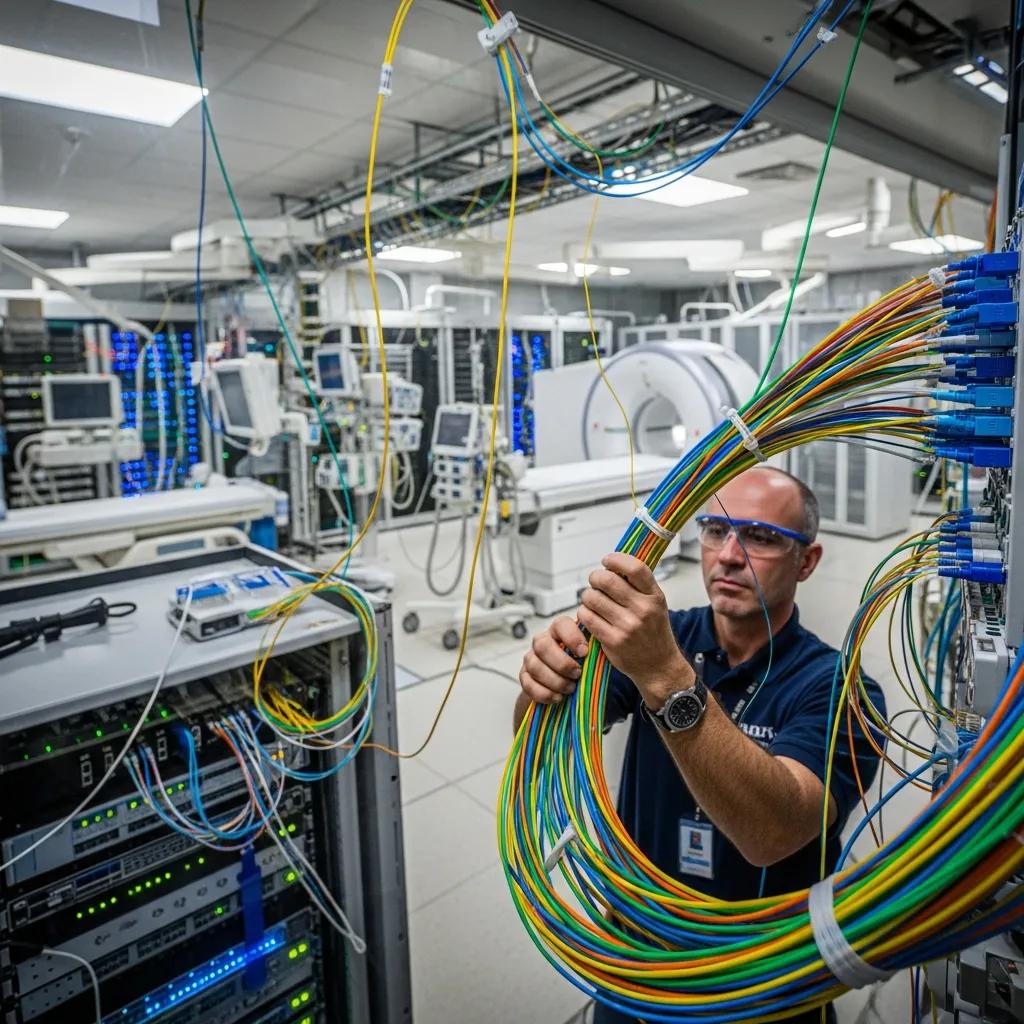
Fiber optic infrastructure is central to delivering high-throughput, low-latency connectivity for telemedicine, EHR synchronization, PACS imaging, and data-center interconnects. A properly designed fiber backbone gives scalable bandwidth and physical separation from copper noise; choosing between multi-mode and single-mode depends on distance, budget, and future growth. Typical architectures pair horizontal copper runs to endpoints with fiber backbone links to aggregation points and data centers, while diverse-path routing and redundant links improve resilience. Below are core backbone strategies that support modern medical workloads and reduce latency for clinical applications.
These strategies prepare facilities for growing telemedicine demand and larger imaging datasets. The following subsections compare multi-mode and single-mode fiber for healthcare uses and explain why backbones matter for imaging workflows.
How Do Multi-mode and Single-mode Fiber Optics Support Telemedicine and EHR Systems?
Multi-mode fiber is well suited to in-building links—typically under 300 meters—where it supports video conferencing, telemedicine carts, and local EHR replication with a lower transceiver cost. Single-mode fiber is the choice for long-distance campus or metro links, remote data replication, and centralized PACS storage, thanks to lower attenuation and greater headroom for future speeds. Proper termination, insertion-loss testing, and OTDR validation are critical to ensure predictable performance for telemedicine platforms and real-time EHR access. A mixed deployment often balances initial cost with long-term scalability.
Understanding these roles clarifies why backbones are sized and routed for imaging and data-center performance, which we cover next.
Why Are Fiber Optic Backbones Vital for Medical Imaging and Data Centers?
Fiber backbones matter because imaging modalities produce large files that must move quickly and reliably between acquisition, PACS, and long-term archives. High-throughput fiber reduces latency for image retrieval and supports many concurrent users during peak periods, improving workflows and diagnostic turnaround. Fiber also enables redundancy—diverse-path interconnects and parallel links—that preserves availability during maintenance or outages. Planning for modular growth and selecting higher-capacity transceivers upfront helps future-proof infrastructure and avoids costly downtime during later upgrades.
Our Specialized Services
Ring and Ping Communications lists fiber installation and backbone provisioning among its healthcare services, delivering certified terminations, OTDR testing, and documentation that support PACS and EHR performance. We provide end-to-end fiber installs—multi-mode and single-mode—coordinated with structured cabling and electrical work, and prepare proposals tailored to Southern California clinics and hospitals. For organizations requiring turnkey fiber backbones, we manage the technical and compliance aspects of the project.
The following section explains how physical security systems integrate with network cabling and which practices protect patient privacy while deploying access control and surveillance.
How Can Medical Offices Improve Security with Access Control and Surveillance Systems?
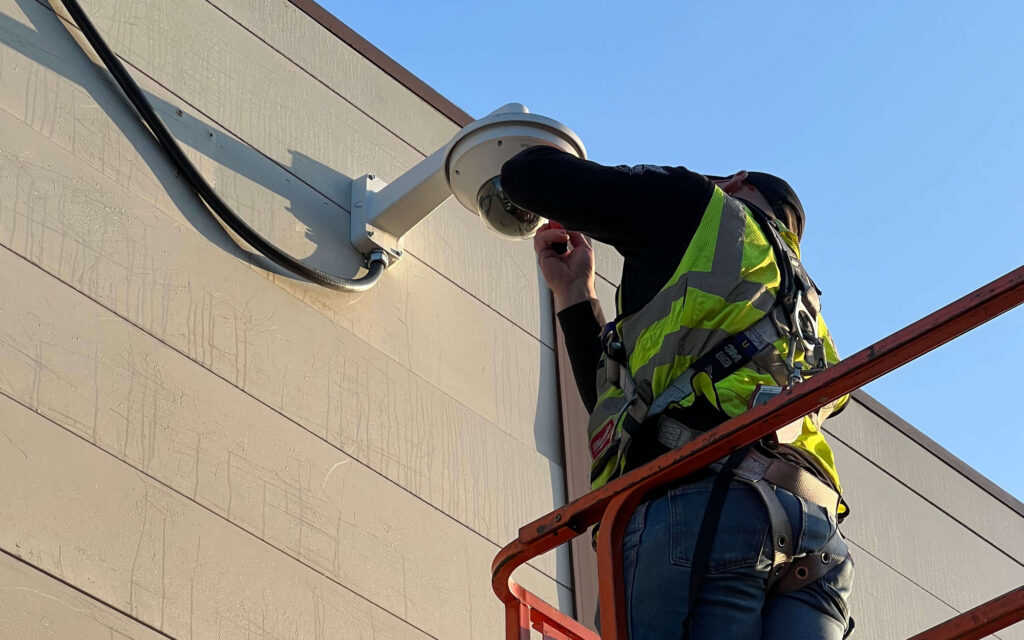
Medical offices strengthen security by combining access control and IP surveillance on segmented networks that protect PHI and limit access to sensitive areas. Integration planning should cover PoE provisioning, dedicated VLANs, secure video storage, and retention policies aligned with privacy requirements. Choose access-control technologies—card systems, biometrics, or mobile credentials—based on audit-logging needs and least-privilege principles for areas like records storage and server rooms. The list below outlines best-practice principles to guide access control and surveillance deployments for clinics.
These measures reduce privacy risk and set the stage for compliant surveillance integration. The next subsections expand on access control choices and surveillance network design.
To support decision-making, the table below compares common access-control and camera options by privacy impact, network requirements, and compliance considerations.
| Security Technology | Integration Attribute | Privacy & Network Considerations |
|---|---|---|
| Card Access (RFID) | Cost-effective, scalable | Requires reliable audit logging and secure credential management to protect access records |
| Biometric Readers | High assurance, privacy-sensitive | Handles personal identifiers; enforce strict storage encryption and consent practices |
| IP Cameras (Edge/Server) | High bandwidth, storage-intensive | Plan VLANs, encrypted storage, and retention controls to prevent PHI exposure |
This comparison helps decision-makers weigh privacy against assurance when selecting access control and surveillance technologies. The following subsection focuses on choosing access control while preserving privacy.
What Access Control Technologies Protect Patient Privacy in Healthcare Settings?
Access control protects patient privacy by restricting physical and logical entry to areas that store or process PHI and by creating audit trails showing who accessed sensitive locations and when. Card access systems scale well and produce manageable logs; biometric systems increase assurance but require careful handling of biometric templates and compliance safeguards. Mobile credentials add flexibility but must be paired with secure identity management and revocation workflows. Regardless of technology, apply least-privilege principles, review access lists regularly, and retain logs securely to support investigations. These practices reduce unauthorized access and strengthen your compliance posture.
Next we cover how surveillance systems should integrate with medical networks to balance security, bandwidth, and retention needs.
How Do Surveillance Systems Integrate with Medical Network Infrastructure?
Surveillance systems should run on dedicated VLANs, use PoE switches with UPS protection, and store video on platforms that support encrypted retention and role-based access. High-resolution cameras can consume substantial bandwidth and storage; planners should estimate expected bitrates and select edge- or centralized-recording strategies to balance performance and cost. Never mix surveillance traffic with EHR or PACS networks, and strictly control access to video archives with auditing to prevent inadvertent PHI exposure. Regularly review retention policies and implement secure deletion routines to maintain privacy while meeting recordkeeping requirements.
With security and connectivity in place, facilities need a structured approach to upgrades and maintenance to keep systems reliable, as covered in the final central section.
What Are Best Practices for Network Upgrades and Maintenance in Healthcare Facilities?
Best practices for upgrades and maintenance begin with a formal audit, followed by a phased upgrade plan, rigorous testing, and scheduled preventive maintenance to minimize downtime and protect clinical services. Audits reveal cabling defects, capacity shortfalls, and power or redundancy gaps; a phased approach limits clinical disruption by working in low-demand windows and using temporary redundancy. Document every change, test result, and rollback plan to create the traceability auditors expect. The stepwise checklist below maps an audit-to-maintenance workflow clinics and hospitals can adopt to ensure network reliability and support future growth.
These steps close the loop from discovery to sustained operations and prepare facilities for future demand. The following subsections detail audit practices and future-proofing strategies.
Ring and Ping Communications offers maintenance contracts, system audits, and documentation services tailored to Southern California medical offices, including certified cabling retesting, electrical checks, and scheduled preventive maintenance. Our maintenance packages include audit reports, prioritized remediation recommendations, and options for recurring testing—helping facilities reduce downtime and meet inspection documentation requirements. Contact us to request an audit or quote and receive a prioritized plan for upgrades and ongoing support.
How Do Regular System Audits Prevent Downtime and Ensure Network Reliability?
Regular audits prevent downtime by finding weak links—aging cables, failing UPS batteries, or misconfigured switches—and by exercising failover procedures before an outage occurs. An effective audit checklist includes cabling certification reports, power-load and battery-health tests, patch-panel verification, and device configuration backups. Audit frequency depends on facility size and criticality, but quarterly or biannual checks are common for clinics with high uptime needs. Audit results feed prioritized maintenance and replacement schedules, lowering the risk of unplanned outages and keeping EHR, telemedicine, and imaging systems available.
Those audit-driven improvements lay the groundwork for future-proof infrastructure planning covered next.
What Future-Proofing Strategies Support Growing Medical IT Infrastructure Needs?
Future-proofing includes installing higher-capacity cabling like CAT6A and fiber backbones, reserving conduit and pull space, deploying modular racks and scalable patching, and planning PoE capacity with headroom for new devices. Design spare pathways and document reserve capacity so adding telemedicine carts, IP cameras, or wireless APs causes minimal disruption. Include power headroom in UPS and generator plans and conduct scheduled utilization reviews to align infrastructure with IT strategy. Investing in modular, well-documented systems lowers total cost of ownership and simplifies later upgrades.
These tactics complete the roadmap from audit to long-term resilience, enabling medical offices to scale without compromising patient care or compliance.
Frequently Asked Questions
What are the benefits of using fiber optic cabling in medical facilities?
Fiber delivers high bandwidth and low latency—critical for telemedicine and large imaging files. It’s immune to electromagnetic interference, which helps reliability near sensitive equipment, and it supports longer runs without signal loss, making it ideal for campus or building-to-building links. Fiber’s scalability lets healthcare organizations grow capacity without frequent infrastructure changes.
How can medical offices ensure compliance with electrical safety standards?
Follow the NEC (NFPA 70) and NFPA 99 guidance: implement dedicated circuits for critical devices, maintain proper grounding, and run scheduled tests for UPS and generators. Keep thorough documentation of installations and test results for audits, and use licensed electrical contractors experienced with healthcare requirements to ensure work meets AHJ expectations.
What role does network segmentation play in healthcare data security?
Segmentation isolates sensitive traffic—like PHI—from less secure network areas. Using VLANs for PHI, guest access, and operational devices reduces the attack surface and simplifies monitoring and incident response. Segmentation supports HIPAA controls by containing breaches and making audits and forensic work more straightforward.
How often should maintenance checks be performed on medical cabling and electrical systems?
Quarterly or biannual checks are common, depending on facility size and criticality. Regular audits catch problems—aging cabling, failing UPS batteries, misconfigurations—before they cause outages. A routine maintenance schedule helps keep systems compliant and reduces the risk of downtime that could affect patient care.
What are the key considerations when integrating surveillance systems in medical offices?
Ensure surveillance runs on segmented networks, supports encrypted storage, and follows retention policies that protect privacy. Plan for the bandwidth and storage requirements of high-resolution cameras, use UPS-backed PoE for continuity, and audit access logs regularly to prevent unauthorized viewing of recorded footage.
What types of access control technologies are most effective in healthcare settings?
Card access systems, biometric readers, and mobile credentials all have uses. Card systems scale well and provide clear logs; biometrics add assurance but demand strict template-handling and privacy controls; mobile credentials are flexible but require secure identity management. Apply least-privilege access and review permissions regularly, regardless of technology choice.
How can healthcare facilities prepare for future IT infrastructure needs?
Plan for higher-capacity cabling, spare conduit and fiber, modular racks, and PoE headroom. Schedule regular utilization reviews and build power capacity into UPS and generator plans. Clear documentation and modular designs make future upgrades faster and less disruptive.
Conclusion
Comprehensive cabling and electrical planning strengthen operational reliability, support HIPAA compliance, and protect patient data. By aligning structured cabling, resilient electrical systems, and thoughtful security controls, medical offices create a safer, more efficient environment for staff and patients. Proactively auditing, upgrading, and maintaining infrastructure prepares facilities for future needs and technological change. Contact us to discuss a tailored plan for your medical office and schedule an on-site assessment.