Demystifying Access Control: Your Essential Glossary for Smarter Security
The Security Solutions Expert Team comprises certified professionals with decades of combined experience in designing, implementing, and managing advanced security systems across diverse industries. Their deep understanding of evolving threats and regulatory landscapes ensures that the insights provided are not only comprehensive but also actionable and rooted in real-world expertise.
Getting security right starts with speaking the same language. Understanding the lingo of access control empowers businesses throughout Southern California to pinpoint and deploy the perfect door and security solutions for their unique needs. We know that translating technical jargon into actionable security can be a hurdle, often leaving gaps in protection and compliance. This guide cuts through the complexity, offering clear definitions, explaining how things work, and highlighting the real benefits of each term. We’ll explore five key areas:
- The foundational concepts and processes of security systems
- Different access control approaches, illustrated with real-world scenarios
- The essential hardware that makes it all happen
- Crucial operational features and the terms you need to know
- Cutting-edge technologies and how they apply locally
Whether you’re managing a bustling warehouse, a sensitive healthcare facility, a busy call center, or a high-stakes financial operation in Orange County, Los Angeles, Riverside, or San Diego, this guide will demystify the terms and connect them directly to the advantages for your business.
What Exactly Is an Access Control System? Key Terms and Concepts Unpacked
An access control system is your frontline defense, a smart solution designed to verify who someone is, enforce your security rules, and decide who gets in and who stays out of protected areas. It’s a powerful combination of physical and electronic measures that boosts safety, keeps unauthorized individuals at bay, and keeps your operations running smoothly. Think of a manufacturing plant where badge readers and electronic locks ensure only trained personnel can access critical production zones – that’s security and efficiency working hand in hand.
How Does Physical Access Control Fortify Your Business?
Physical access control acts as a vigilant gatekeeper, preventing unauthorized entry by meticulously verifying identities, managing credentials, and enforcing lock policies. By confirming badges, PINs, or even fingerprints at every entry point, it deters potential intruders and meticulously logs every access attempt. Imagine a law firm where biometric scanners restrict access to sensitive client file rooms, not only preventing theft but also providing a clear audit trail for compliance.
What Are the Core Building Blocks of an Access Control System?
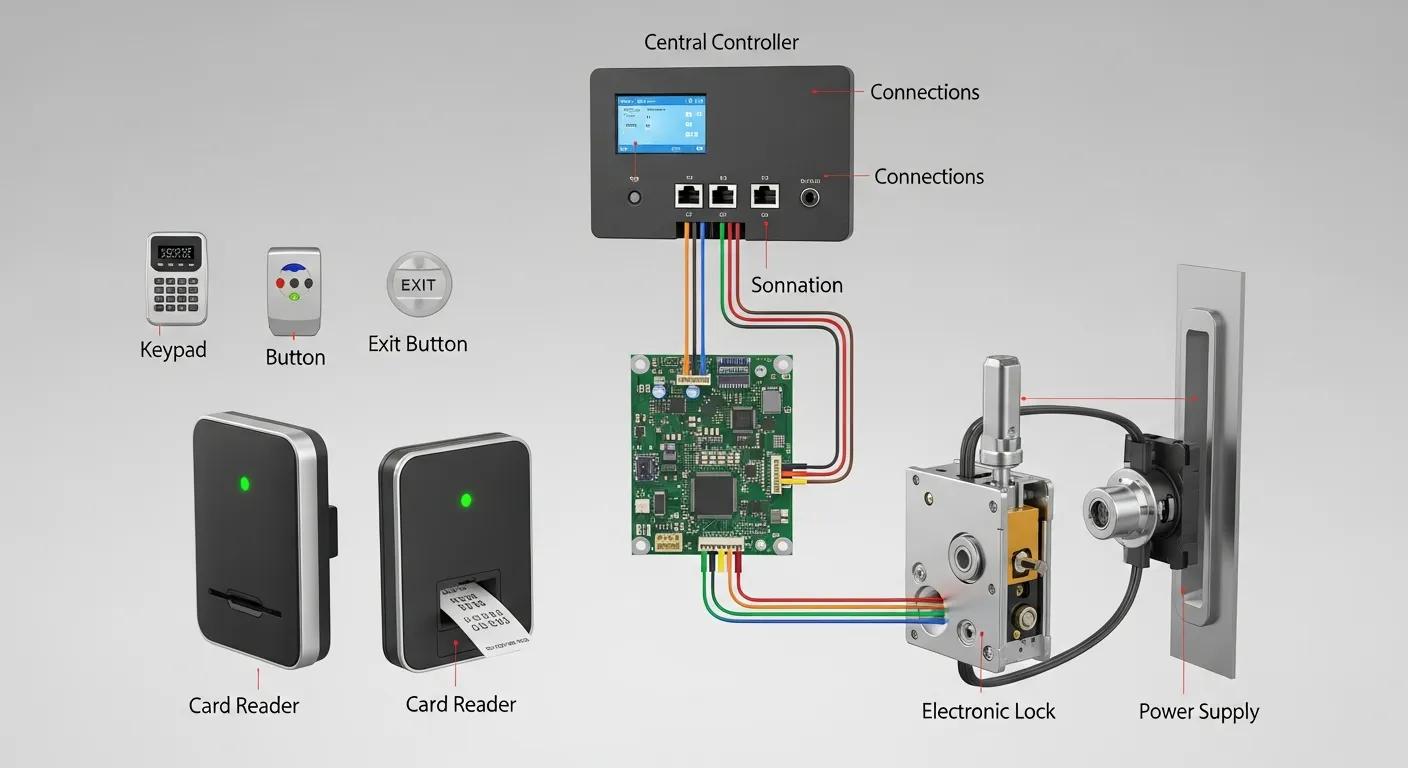
At its heart, an access control system comprises readers, credentials, locks, and controllers that work in concert. Readers are the first point of contact, scanning credentials like cards or biometrics. Controllers are the brains, processing the authentication and making the decisions. Locks are the physical barriers, and panels orchestrate the entire system. Together, these elements ensure that only valid credentials can unlock protected doors, delivering both unwavering reliability and detailed traceability.
What's the Difference Between Authentication and Authorization in Access Control?
Authentication is all about proving you are who you say you are – it’s the process of validating your credentials. Authorization, on the other hand, is about determining what you’re allowed to do or access once your identity is confirmed, based on predefined policies. For example, swiping your badge at a reader authenticates you, and then the system checks your authorized access level before unlocking the door, ensuring your identity matches your permissions.
Why Are Access Levels Crucial for Effective Security Management?
Access levels are the smart way to segment permissions, assigning specific privileges based on a person’s role or location. This “least privilege” approach minimizes risk by ensuring that individuals have access only to what they absolutely need. Defining levels such as “General Staff,” “Supervisors,” or “Management” ensures that access to sensitive areas is strictly controlled by job function, preventing unauthorized movement within your facilities and supporting both safety and regulatory compliance.
Exploring Access Control Models: Definitions and Real-World Examples
A systematic literature review for authorization and access control: definitions, strategies, and models
This systematic review offers a comprehensive overview of authorization and access control
, examining existing definitions, strategies, and models. It classifies various access controlmodels, including Role-Based Access Control(RBAC) and Attribute-Based Access Control(ABAC), and discusses their core components and interactions within security systems.
This research directly supports the article’s foundational definitions of access control
systems, its components, and the various access controlmodels discussed, such as DAC, MAC, RBAC, and ABAC.
What Is Discretionary Access Control (DAC) and How Does It Operate?
Discretionary Access Control (DAC) grants or revokes access directly to resource owners. In a busy call center, a team lead might grant specific agents access to certain client folders, fostering collaboration but requiring careful management to prevent permissions from expanding unnecessarily.
How Does Mandatory Access Control (MAC) Elevate Security?
Mandatory Access Control (MAC) imposes strict, centrally dictated security policies that individual users cannot override. This model is often employed in high-security environments such as government agencies and healthcare facilities, where data classification labels (e.g., “Confidential,” “Restricted”) are enforced to prevent sensitive information from falling into the wrong hands and to ensure compliance with regulations such as HIPAA.
What Is Role-Based Access Control (RBAC) and What Are Its Advantages?
Role-Based Access Control (RBAC) simplifies security management by assigning permissions to job roles rather than individual employees. In a warehouse setting, roles such as “Picker,” “Supervisor,” and “Inventory Manager” each have their own set of access rights, drastically reducing the need for manual configuration and making onboarding new team members easier.
How Does Attribute-Based Access Control (ABAC) Stand Apart?
Attribute-Based Access Control (ABAC) takes a more dynamic approach, evaluating various attributes—like the time of day, the type of device being used, or the user’s department—to make real-time access decisions. For instance, a financial system might only permit access to sensitive documents during standard business hours and exclusively from company-approved devices, adding a crucial layer of contextual security.
What Is Rule-Based Access Control and When Is It the Best Fit?
Rule-Based Access Control relies on system-defined rules, such as time constraints or event triggers, to permit or deny entry. This is perfect for scenarios like automated after-hours lockdowns, where doors automatically secure at a set time and unlock the next morning, ensuring consistent policy enforcement without manual intervention.
Key Access Control System Components You Need to Know
Every access control setup is a carefully chosen blend of hardware and software components, meticulously selected to match the specific site requirements and risk assessments.
What Are Card Readers and How Do They Function?
Card readers are the devices that detect and interpret the data stored on credentials, typically proximity or smart cards, using RFID technology. When a valid card is presented, the reader swiftly transmits its unique identifier to the controller, initiating the door release in mere milliseconds.
How Do Biometric Systems Work in Access Control?
Biometric systems capture unique physical characteristics—like fingerprints, iris patterns, or facial structures—and compare them against stored templates to confirm identity. This method significantly strengthens authentication by linking access to inherent personal traits, making credential sharing and unauthorized entry much harder.
What Are Electromagnetic Locks (Maglocks) and Their Applications?
Electromagnetic locks, or maglocks, consist of a powerful electromagnet and a metal plate that create a secure bond when energized. They are a popular choice for high-traffic doors, releasing instantly upon authorized access or power interruption, offering fail-safe operation and seamless integration with push-to-exit buttons.
What Is the Role of Access Control Panels and Controllers?
Controllers and panels serve as the central nervous system of the access control system. They process authentication requests, enforce security policies, and meticulously log all events. They manage multiple readers and locks, communicate with the main management software, and often include backup power to ensure security remains intact even during power outages.
How Are Credentials Used to Authenticate Access?
Credentials—whether they’re physical cards, key fobs, mobile app tokens, or biometric data—act as your digital or physical handshake, proving your identity. The controller verifies each credential against its secure database, matching it to the user’s profile and their assigned access levels, which speeds up entry and provides a comprehensive audit trail.
Understanding Common Access Control Features and Terminology
Operational features and specialized terms are the backbone of advanced security workflows and effective incident response in today’s access control systems.
What Is Anti-Passback and Why Is It Crucial?
Anti-passback is a vital security feature that prevents a credential from being used to enter an area without first being used to exit. This closes a common security loophole that could allow credential sharing. In systems with multiple entry and exit points, it meticulously tracks movements, ensuring each card swipe alternates correctly between entering and leaving.
How Does Tailgating Impact Physical Security?
Tailgating, also known as piggybacking, occurs when an unauthorized individual follows an authorized person closely through a secured entry point. This poses a significant security risk that bypasses access control measures. To combat this, security teams often deploy door sensors, mantrap portals, or turnstiles to deter and detect such unauthorized entries.
What Is a Duress Alarm in Access Control Systems?
A duress alarm is a discreet alert, triggered by a specific credential or code that appears to be a normal access attempt but silently notifies security personnel or authorities. This critical feature provides an added layer of protection for employees under duress, while keeping the system functioning normally.
How Do Request-to-Exit (REX) Devices Function?
Request-to-Exit (REX) devices, such as motion sensors or push-to-exit bars, allow individuals to exit a secured area without presenting a credential. These devices are essential for ensuring safe and quick egress during emergencies while maintaining secure entry protocols, effectively balancing life-safety needs with access control policies.
How Advanced Access Control Technologies Elevate Security

The latest technological advancements are bringing greater flexibility, enhanced user convenience, and more robust remote management capabilities to modern businesses.
What Are Mobile Credentials and What Are Their Benefits?
Mobile credentials leverage smartphones or smart wearables to securely transmit encrypted access tokens via Bluetooth or NFC technology. This innovative approach not only reduces the need for physical hardware but also enables seamless credential provisioning and allows access rights to be updated or revoked instantly, significantly boosting operational agility.
How Is Multi-Factor Authentication Applied in Physical Access Control?
Multi-Factor Authentication (MFA) significantly strengthens security by requiring two or more distinct verification methods—such as a smart card combined with a fingerprint scan. By layering “something you have” with “something you are” (or “something you know”), organizations dramatically reduce the risk of unauthorized access.
What Role Does Cloud-Based Access Control Play for Businesses?
Cloud-Based Access Control utilizes remote, hosted servers to centrally manage security policies and credentials. This enables effortless remote administration, provides real-time reporting, and allows for rapid scalability. Businesses benefit from automatic software updates, reduced on-site infrastructure costs, and 24/7 system support.
How Are RFID Systems Integrated into Door Access Control?
RFID systems embed radio-frequency identification (RFID) tags into credentials and readers, enabling data exchange without direct physical contact or line of sight. This integration is particularly beneficial in high-traffic environments like warehouses, where personnel or even forklifts can present badges from a distance, dramatically speeding up entry and exit processes.
How Do Access Control Terms Relate to Southern California Businesses?
The unique local landscape and specific industry regulations across Southern California significantly influence the requirements for effective access control solutions.
What Access Control Solutions Are Ideal for Warehousing and Manufacturing?
Warehousing and manufacturing facilities thrive with ruggedized readers, industrial-grade controllers, and robust turnstiles designed to withstand demanding environments. Combining role-based permissions with time-based rules ensures that only authorized operators can access heavy machinery and sensitive storage areas.
How Does Access Control Support Compliance in Medical and Legal Sectors?
Facilities in the medical and legal fields face stringent compliance demands, including HIPAA and client confidentiality regulations. Secure audit logs, reliable biometric authentication, and carefully zoned access areas are essential to protecting sensitive records and ensuring they are fully traceable, supporting regulatory audits and robust risk management.
What Are the Security Priorities for Call Centers and Financial Institutions?
Call centers and financial institutions require uncompromised identity verification, detailed activity logging, and dynamic access-level management to safeguard sensitive customer data. Implementing multi-factor authentication and encrypting credential data are critical steps in preventing account takeovers and devastating data breaches.
How Can Businesses Secure Tailored Access Control Consultations?
Organizations throughout Southern California can partner with local security specialists for comprehensive on-site assessments, expert system design, and custom integration solutions. Engaging with experienced consultants ensures that your facility’s unique layout, specific regulatory needs, and operational workflows are addressed with optimal, practical security measures.
Your Top Questions About Access Control Terms Answered
What Are the 3 Primary Types of Access Control?
The three main types of access control are Discretionary Access Control (DAC), Mandatory Access Control (MAC), and Role-Based Access Control (RBAC). Each offers a distinct method for enforcing and managing security policies.
What Are the 4 Essential Components of an Access Control System?
A complete access control system is built on four key components: credentials (such as cards or biometrics), readers, locking mechanisms (such as maglocks or electric strikes), and controllers or panels that process authentication and enforce policies.
What Is Physical Access Control?
Physical access control is a security strategy that restricts entry to buildings, rooms, or specific areas through a combination of mechanical and electronic measures, ensuring that only authorized individuals can gain access.
How Do Access Control Models Differ?
Access control models vary in how they enforce policies: DAC gives control to resource owners; MAC uses centrally managed security labels; RBAC assigns permissions based on job roles; and ABAC employs dynamic attributes for decision-making.
What Constitutes Credentials in Access Control?
Credentials are the digital or physical tokens—ranging from proximity cards and mobile IDs to biometric templates—that serve as proof of identity, enabling secure authentication before access is granted.
Mastering access control means understanding its clear definitions, robust mechanisms, and tailored solutions. By ensuring your team is fluent in these key terms and concepts, you can confidently make informed decisions and significantly enhance the protection of your facilities across Southern California. Get in touch today for specialized consultations and project quotes that translate security terminology into practical, reliable implementations.