Benefits of Energy-Efficient Lighting Upgrades for Commercial Businesses in Southern California
Upgrading outdated lamps and ballasts to modern LED fixtures with smart controls significantly reduces energy consumption, lowers maintenance costs, and improves overall light quality in commercial environments. For Southern California businesses — including warehouses, manufacturing facilities, hospitals, offices, and law firms — LED retrofits deliver measurable kWh savings, reduced operating expenses, and safer, more productive workspaces.
This guide explains how energy savings are achieved, outlines key operational benefits, and highlights available California and utility incentives. It also explores industry-specific solutions and demonstrates how smart lighting controls further enhance returns. You’ll find typical savings ranges, practical examples, rebate guidance, control comparisons, and clear recommendations for selecting fixtures and qualified installers.
The focus is on practical outcomes: maximizing ROI, capturing available rebates, minimizing downtime during installation, and delivering long-term value across Orange County, Los Angeles County, Riverside County, and San Diego County. By the end, you’ll be equipped to estimate energy and maintenance savings, identify incentive opportunities, and plan a retrofit strategy that balances upfront investment, rebates, and day-to-day operational needs.
What Are the Key Energy Savings from Commercial LED Lighting Benefits?
LED retrofits typically cut lighting energy use by 30–75%, depending on the existing technology and whether controls are added. LEDs deliver these savings through higher efficacy (lumens per watt), directional light that reduces waste, and compatibility with dimming and occupancy controls that shorten run-hours. Replacing fluorescent troffers, metal-halide high-bays, or legacy HID fixtures with LEDs typically reduces annual kWh consumption and eases HVAC load because LEDs run cooler. This section quantifies common savings, explains the main efficiency drivers, and includes a comparative fixture table to show the energy and maintenance differences that drive ROI. The examples and comparisons that follow help facility teams turn fixture choices into annual cost and maintenance projections.
At the fixture level, LEDs replace low‑efficacy lamps with units that produce more usable light per watt, while optics and controls focus light where it’s needed. Understanding those differences makes it easier to see how a retrofit delivers immediate energy reductions and long-term maintenance savings. The next subsection gives a direct calculation example for a typical facility.
How Much Can Businesses Save on Energy Costs with LED Lighting?
Most projects yield 30–75% savings on lighting energy. Warehouses and high‑bay installations are typically at the higher end; interior office retrofits are closer to the middle. Results depend on the baseline equipment, annual operating hours, fixture efficacy gains, and whether controls are installed. For example, converting 100 fixtures each drawing 400 W (HID) to 150 W high‑bay LEDs reduces load by 25 kW per hour. At 3,000 annual hours and $0.18 per kWh, the annual savings are roughly 25 kW × 3,000 × $0.18 = $13,500. Use this simple formula to quickly generate side‑by‑side business‑case estimates. Adding dimming schedules or daylight harvesting usually increases savings and shortens payback.
These numeric benchmarks support budgeting and rebate targeting and provide a closer look at why LEDs are inherently more efficient.
What Makes LED Lighting More Energy Efficient Than Traditional Options?
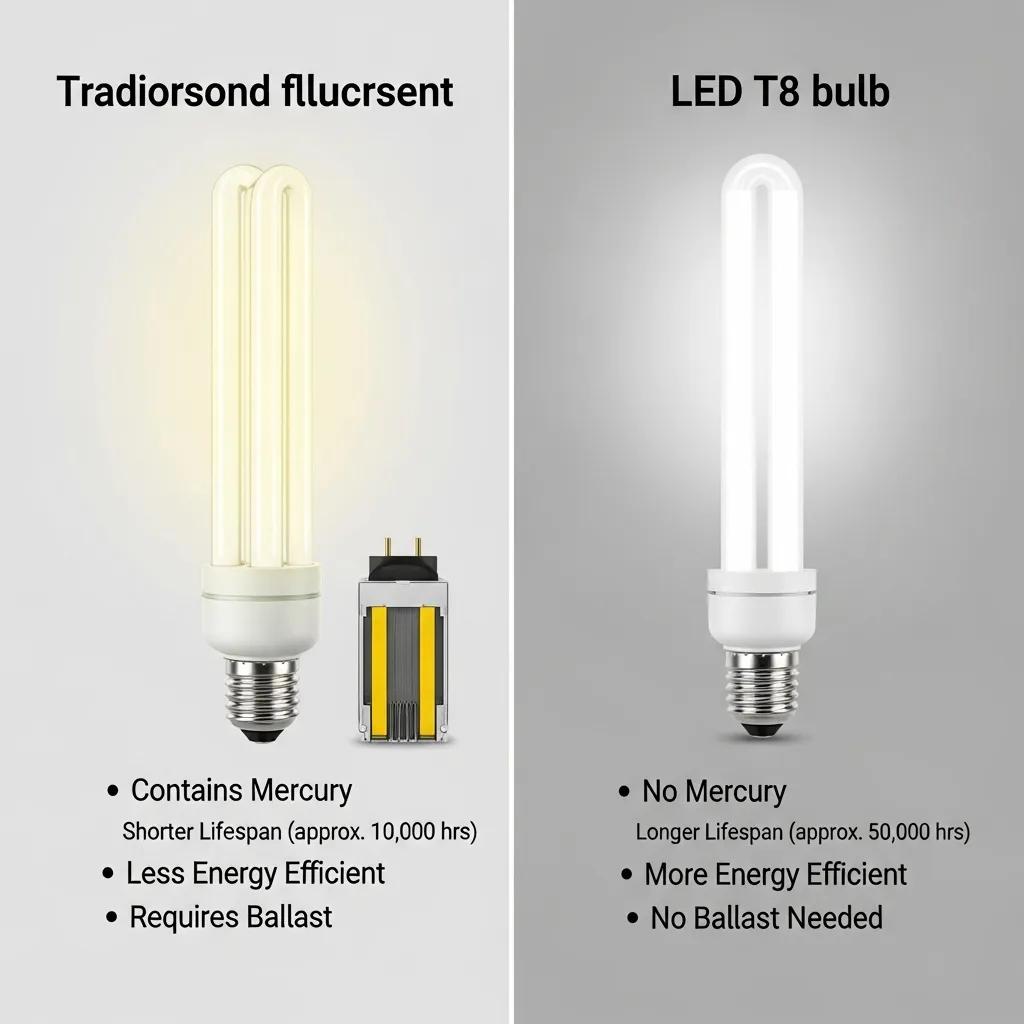
LEDs outperform fluorescents and HIDs primarily because they deliver more lumens per watt, lose less light within the fixture, and use more efficient drivers that reduce wasted energy. Modern commercial LEDs typically deliver 120–170 lm/W, compared with 50–100 lm/W for older fluorescent or HID systems, so fewer watts are required to produce the same usable light. Directional optics and well‑designed fixtures cut spill and improve uniformity, which can mean fewer fixtures or lower lumen packages to meet illuminance targets. LEDs also run cooler and avoid ballast losses associated with legacy lamps, reducing HVAC interaction and total building energy use. Those technical strengths are the backbone of energy‑savings calculations, making LEDs ideal for retrofit projects where layout and controls can be optimized.
| Fixture Type | Typical Wattage (Replaced) / LED Wattage | Estimated Annual Energy Use Change |
|---|---|---|
| HID High-Bay → High-Bay LED | 400 W → 150 W | ~62% kWh reduction per fixture |
| Fluorescent Troffer → LED Troffer | 4×32 W → 40–50 W linear LED | ~50–60% kWh reduction per fixture |
| CFL/PAR Retrofit → LED Downlight | 75 W → 18–25 W | ~70% kWh reduction per fixture |
How Do Energy-Efficient Lighting Solutions Improve Business Operations?
Beyond energy and cost savings, LED upgrades improve operations by delivering better light quality, fewer maintenance interruptions, and more consistent performance. Higher CRI and improved uniformity increase task accuracy in manufacturing and reduce inspection errors, while stable, tunable light in offices improves comfort and staff satisfaction. Fewer lamp changes and longer service intervals reduce labor, lift rentals, and production downtime in facilities with high ceilings. Those operational gains are indirect but meaningful— they complement measured energy savings and strengthen the retrofit business case. Below, we outline specific productivity and safety outcomes and include a contractor-deployment example demonstrating fast, low‑disruption installation.
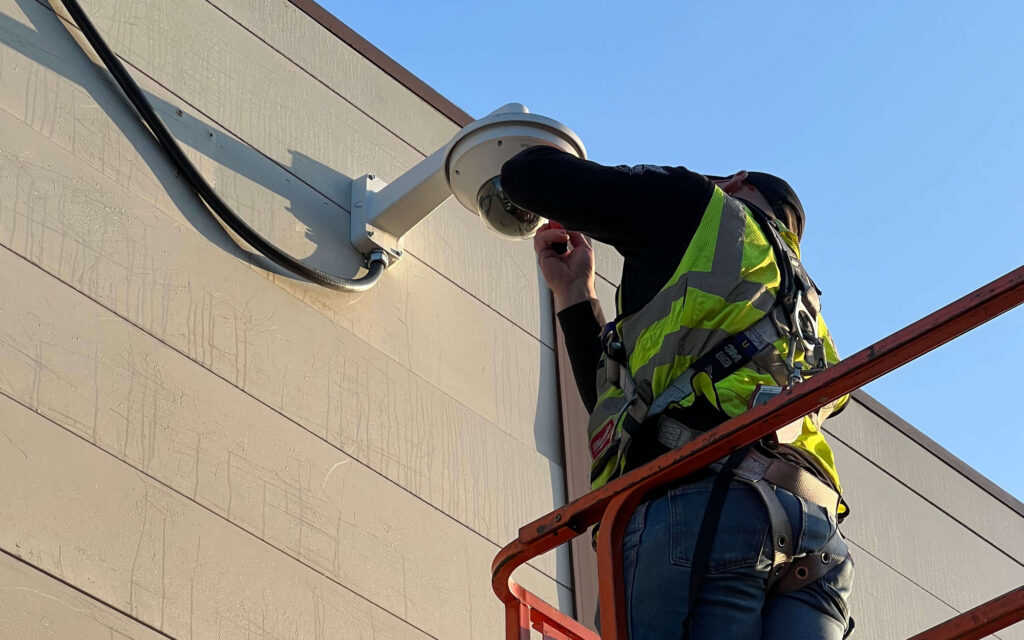
Better lighting directly supports productivity: improved visibility and reduced eye strain help teams perform detailed tasks more accurately. Modern LED systems also enable predictable maintenance schedules through long‑life ratings and far fewer emergency failures, simplifying inventory and planning. Ring and Ping Communications has completed rapid deployments for commercial clients across Southern California, coordinating low‑voltage wiring and fixture swaps to minimize downtime and keep sites safe—an approach that often accelerates payback. That operational reliability leads to a discussion of color rendering, CRI, and other visual factors that affect performance.
In What Ways Does Improved Lighting Quality Enhance Workplace Productivity?
Higher color rendering index (CRI), the correct correlated color temperature (CCT), and uniform illuminance reduce visual errors and cognitive fatigue in offices and industrial areas. A CRI of 80–90+ improves color discrimination for quality control, medical assessments, and fine assembly, while neutral-to-slightly-cool CCTs in task zones sharpen alertness. Offices and law firms benefit from low‑glare fixtures and consistent lighting that reduce screen reflections and make reading easier, improving focus. Improved lighting also reduces complaints and task errors, yielding soft‑cost savings that complement energy benefits and justify investing in better fixtures.
How Do Reduced Maintenance Costs Impact Commercial Lighting Efficiency ROI?
LEDs commonly exceed 50,000 hours of life—many times longer than fluorescent tubes or HID lamps—dramatically cutting replacement labor, parts, and lift charges. In tall or wide facilities, savings from avoided lift rentals and less scheduled downtime can rival or exceed energy cost reductions within a few years. Maintenance line items that decline with LEDs include lamp and ballast purchases, hazardous-waste-disposal fees, and emergency service calls. When you add maintenance savings to simple energy payback, the total cost of ownership often shows a shorter payback and higher internal rate of return, especially when you factor in utility rebates and tax incentives.
These maintenance benefits influence procurement decisions and the decision to pursue advanced controls; the next section outlines rebate programs that can further improve project economics.
Which Energy Efficient Lighting Rebates and Incentives Are Available for Businesses?
Southern California businesses can access rebates from utilities, municipal programs, and state energy‑efficiency initiatives to lower upfront LED costs. Common sources include major utilities’ commercial lighting rebate programs, city or county retrofit grants, and statewide funding for prescriptive and custom projects. Eligibility depends on project type, fixture class, and whether pre‑approval is required; many rebates are a fixed amount per fixture or a percentage of project cost. This section lists typical rebate sources, compares program features, and gives a practical checklist for accessing funds. Knowing these programs up front is essential to maximizing value and shortening payback.
This checklist highlights the common milestones and documents that reduce the risk of rebate denial. The comparison table below shows representative program features for Southern California businesses.
| Estimated $20–$120 per fixture, depending on type | Eligible Projects / Process | Typical Incentive Value |
|---|---|---|
| Utility Commercial Lighting Program | Prescriptive and custom LED retrofit; requires equipment specs and application | Varies widely; often covers a portion of the project cost |
| Municipal Retrofit Grants | Building-level upgrades in select cities; competitive or first-come programs | Project-specific funding can be significant for large projects |
| State Energy Efficiency Programs | Custom industrial and retrofit projects with measurement & verification | Project-specific funding; can be significant for large projects |
This comparison helps facility teams pick programs that match project scale and shows where contractor support speeds approvals. Next, practical tips and a clear application process make it easier to pursue incentives.
How Can Southern California Businesses Access Utility Rebates for LED Upgrades?
To capture the most rebates, verify eligibility early, get pre‑approval when required, document fixture models and serial numbers, and schedule any post‑install inspections promptly. Typical documentation includes cut‑sheets, contractor invoices, operating hours, and baseline lighting descriptions. Coordination between your facility team, electrical contractors, and the rebate administrator simplifies the process and speeds payments. Contractors experienced with utility procedures can prepare accurate incentive calculations and ensure installations meet program specifications, reducing the risk of retroactive adjustments.
What Are the Steps to Apply for California Energy Efficiency Programs?
The application process generally follows three phases: initial audit and eligibility check; application and pre‑approval (if needed); and post‑install verification and rebate claim. First, do a baseline lighting audit to record existing fixtures, operating hours, and measured illuminance—this establishes eligibility and rebate estimates. Second, submit a formal application with proposed fixtures and calculations, seeking pre‑approval as required to secure incentives. Finally, after installation, compile the verification documentation—including invoices, photos, and measurement data—and submit the rebate claim. Timelines vary, but plan for several weeks to a few months from pre‑approval to rebate payment on most commercial jobs.
Following these steps reduces administrative hold‑ups and maximizes incentive capture. The next section addresses industry‑specific lighting strategies that align with rebate pathways.
Ring and Ping Communications helps clients identify eligible programs, prepare documentation, and coordinate pre‑approval and post‑install verification to streamline rebate capture and reduce client effort. Businesses ready to bid or receive rebate support can request a free lighting audit or project quote by phone, email, or through the company’s local business listing.
What Industry-Specific Benefits Do Energy-Efficient Lighting Upgrades Offer?
Each commercial sector benefits from fixture and control choices that match its operational needs while delivering energy savings. Warehouses and manufacturing facilities typically require high‑bay fixtures and a wide, uniform distribution to support safety and throughput. Hospitals often require tunable white systems and high CRI for clinical accuracy. Offices and law firms prioritize low‑glare fixtures, visual comfort, and circadian‑friendly lighting to support staff well‑being. Matching fixture families and control strategies to each industry ensures energy savings without sacrificing task performance. The sections below outline benefits and recommended solutions for industrial and professional environments.
Picking the right fixture and control mix also affects rebate eligibility and ROI, so pair technical specs with operational requirements when planning upgrades. The next subsection focuses on warehouses and manufacturing.
How Do LED Upgrades Benefit Warehouses and Manufacturing Plants?
In high‑bay industrial spaces, LED high‑bay fixtures deliver high lumen output with improved uniformity at mounting heights, often allowing fewer fixtures and lower kWh use. Better vertical illuminance and reduced glare improve operator safety and accuracy on assembly lines and in storage aisles. Long LED lifetimes reduce costly lift rentals and scheduled downtime for lamp replacement—critical in tall-racking environments. Typical high‑bay retrofits can reduce energy use by 50–70% and significantly reduce maintenance events, yielding attractive paybacks when paired with utility incentives.
What Lighting Solutions Are Best for Hospitals, Offices, and Law Firms?
Hospitals benefit from tunable white systems that support circadian health and clinical variability, combined with high‑CRI fixtures for accurate color rendering. Offices and law firms often choose recessed linear or troffer‑style LEDs with even light distribution and low‑glare optics to minimize screen reflections and improve reading comfort. Adding scheduling controls and occupancy sensors boosts savings while preserving occupant comfort in spaces with variable use. Across these environments, specifying suitable CCT ranges, CRI targets, and dimming compatibility produces systems that support human factors and energy goals.
This quick guide clarifies fixture selection by objective and prepares you for the discussion of smart controls that follows.
How Do Smart Lighting Controls Enhance Commercial Lighting Efficiency?
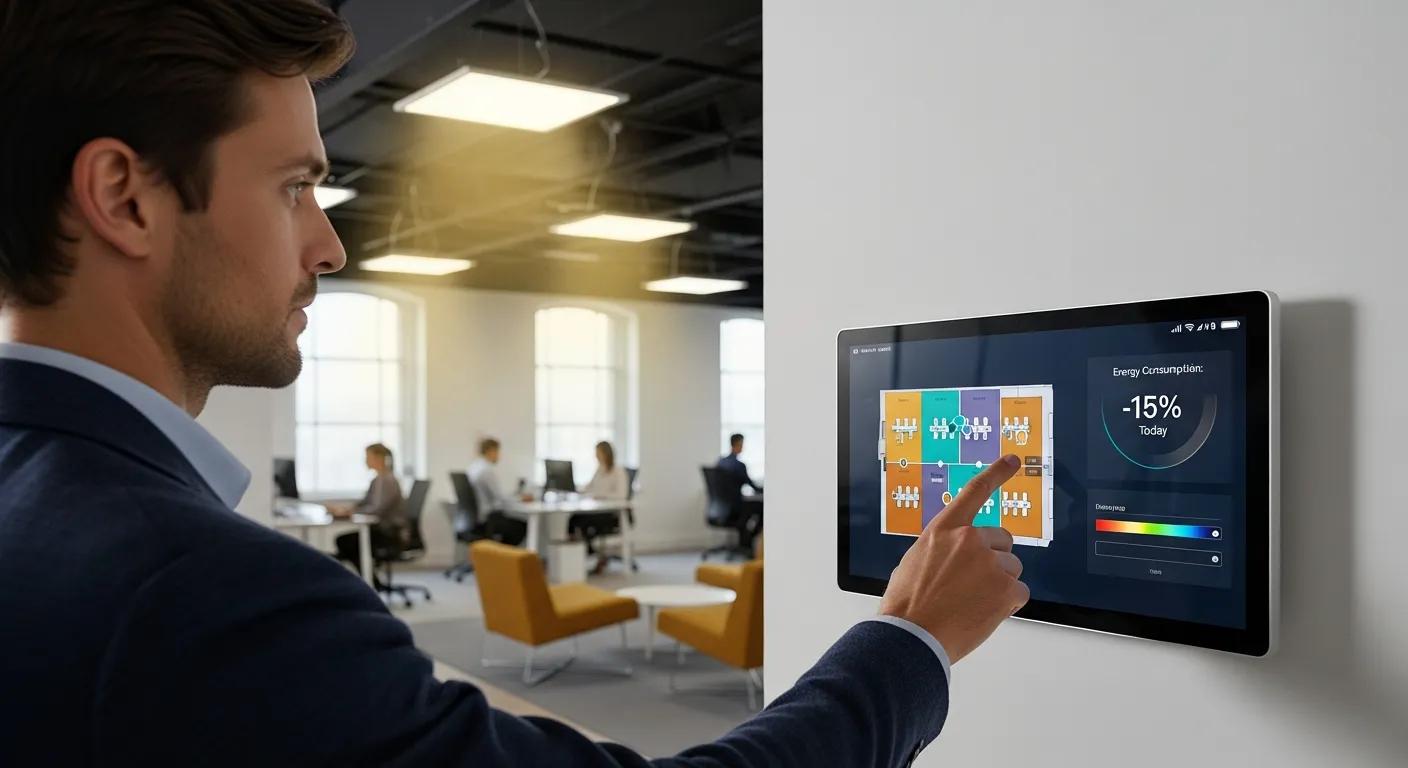
Smart lighting controls—occupancy sensors, daylight harvesting, and networked control systems—save energy by automatically matching light output to actual use and available daylight. Controls enable scheduling, zoned dimming, and real‑time monitoring, which compound fixture‑level savings and provide operational visibility. Networked lighting can tie into building management or IoT platforms for analytics, predictive maintenance, and centralized scheduling, delivering both energy and labor efficiencies. The table below compares control types by purpose, impact, and typical use cases to help decision‑makers prioritize investments. After the table, we cover practical installation tips and common pitfalls.
| Control Type | Primary Function | Estimated Energy Impact |
|---|---|---|
| Occupancy Sensors | Automatically switch or dim lights based on presence | 10–40% reduction in active lighting energy |
| Daylight Harvesting | Dim electric lighting when sufficient daylight is present | 20–60% reduction in daylit zones |
| Networked Controls | Central scheduling, monitoring, and analytics | Cumulative 25–60% reductions depending on use cases |
Controls not only reduce energy use but also improve the occupant experience by keeping light levels appropriate and reducing the need for manual overrides. The next subsection explains the benefits of integrating smart lighting with broader IoT and building systems.
What Are the Advantages of Integrating Smart Lighting and IoT Systems?
Networked lighting centralizes control—allowing remote scheduling, fault detection, and performance analytics that reduce wasted energy and shorten maintenance response times. Data from luminaires and sensors reveals occupancy patterns and fixture runtimes, enabling behavior‑based savings and predictive maintenance. Integration with building management systems creates opportunities for demand response, daylight‑linked HVAC coordination, and enterprise commissioning. Those capabilities extend ROI beyond fixture efficiency to operational optimization and lower labor costs for troubleshooting and replacements.
How Do Occupancy Sensors and Daylight Harvesting Reduce Energy Use?
Occupancy sensors cut energy by switching or dimming lights when spaces are unoccupied, with typical reductions from ~10% in fully occupied areas to ~40% in intermittently used spaces. Daylight harvesting uses photosensors to dim electric lighting in response to available daylight, delivering 20–60% savings in perimeter zones depending on sensor granularity and glazing. Together, these strategies reduce both run hours and lumen output, producing compounded savings and shorter paybacks. Deployment best practices include correct sensor placement, careful calibration to avoid nuisance switching, and logical network grouping to prevent unwanted interactions.
This list highlights the operational levers controls add before we cover contractor selection and guarantees.
Why Choose Ring and Ping Communications for Energy-Efficient Lighting Upgrades?
Ring and Ping Communications is a Southern California contractor that specializes in low‑voltage wiring and electrical services for commercial and industrial clients, offering integrated lighting installations and LED retrofits. We act as a single point of coordination for network cabling, fiber, electrical, surveillance, access control, audio‑visual, and lighting, which reduces friction on complex retrofit projects.
Selecting a contractor that handles both low‑voltage wiring and lighting installs cuts scheduling headaches, ensures consistent technical specs, and shortens timelines. Ring and Ping Communications backs work with a 90‑day labor guarantee and references a lifetime manufacturer’s warranty on certified cabling installs, protecting project outcomes and system uptime. Those assurances, combined with contractor‑led rebate support and fast-deployment strategies, make upgrades less disruptive to commercial operations.
In addition to cabling, Ring and Ping Communications offers full electrical services, so your lighting upgrade—from power distribution to fixture mounting—can be handled by a single trusted team.
What Guarantees and Warranties Support Our Lighting Installation Services?
We provide a 90‑day labor guarantee that covers installation workmanship and offers a clear path for corrective work in the immediate post‑install period. The company also references a lifetime manufacturer’s warranty for certified cabling installations for low‑voltage systems, protecting the network and control wiring that support advanced lighting platforms. These warranty elements reduce implementation risk, encourage the use of certified components, and set expectations for service response and claims. Clients should confirm the scope and documentation during scoping to ensure warranty coverage aligns with project needs.
How Can Businesses Request a Free Lighting Audit or Project Quote?
Requesting a free lighting audit or project quote is a three‑step process: contact, audit, proposal. First, reach out by phone, email, or the company’s local business listing to describe your facility and goals. Second, schedule a free lighting audit: we’ll walk the site, document baseline kWh and fixture inventory, and check rebate eligibility. Third, receive a detailed proposal with recommended fixtures, controls, incentive estimates, and a project timeline to support your decision. Ring and Ping Communications accepts inquiries at (714) 617-4025, by email at [email protected], or through its local business listing for businesses interested in audits and quotes.
These practical points give a clear path for Southern California businesses ready to turn lighting inefficiencies into operational and financial gains.
Frequently Asked Questions
What are the environmental benefits of switching to energy-efficient lighting?
Switching to LEDs reduces electricity demand and, in turn, lowers greenhouse gas emissions from power generation. Longer lifespans mean fewer replacements and less waste sent to landfills. The switch supports corporate sustainability goals and can enhance a business’s reputation with eco‑conscious customers and stakeholders.
How do energy-efficient lighting upgrades affect employee health and well-being?
Improved lighting reduces eye strain and visual fatigue, which supports comfort and productivity. Tunable white systems can better align indoor lighting with circadian patterns, helping sleep and overall well‑being. A better-lit, more comfortable space also helps attract and retain employees.
What are the common challenges businesses face when upgrading to energy-efficient lighting?
Common challenges include upfront costs, installation disruption, and staff training for new systems. Navigating rebate programs and meeting local requirements can also be complex. Mitigate these risks by planning carefully, choosing experienced contractors, and leveraging available incentives. Clear communication with staff eases the transition and improves acceptance.
How can businesses measure the success of their lighting upgrade projects?
Track KPIs such as kWh savings, reduced maintenance costs, and any productivity or safety changes. Conduct pre‑ and post‑installation energy audits to quantify kWh reductions, and collect employee feedback on lighting quality and comfort. Regularly reviewing these metrics verifies ROI and informs future decisions.
What role do smart controls play in maximizing energy savings?
Smart controls—occupancy sensors, daylight harvesting, and networked systems—ensure lights operate only when needed and at the right levels. They provide analytics that help optimize schedules and spot faults, boosting savings beyond fixture efficiency alone. Controls are a key lever for operational and energy performance.
Are there specific industries that benefit more from energy-efficient lighting upgrades?
Certain sectors see especially strong gains. Warehouses and manufacturing benefit from high‑bay LEDs that improve visibility and safety while lowering costs. Hospitals need high‑CRI, tunable systems for clinical accuracy. Offices and law firms gain from low‑glare, uniform fixtures that improve visual comfort. Tailoring solutions to industry needs ensures energy savings without sacrificing task performance.
Conclusion
Upgrading to energy‑efficient lighting delivers clear benefits: lower energy bills, reduced maintenance, and safer, more productive spaces. With available rebates and smart project planning, businesses can accelerate payback and improve the total cost of ownership. Take the next step: request a lighting audit and see how a tailored retrofit can improve your bottom line and workplace experience. Contact us to explore solutions that match your facility and goals.